

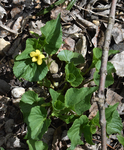
Violaceae: Viola eriocarpa
Files
Family Name
Violaceae
Common Name
Smooth Yellow Violet
Description
Viola eriocarpa is a long-lived perennial, caulescent herbaceous forb that arises from a short, thick, horizontally creeping underground rhizome supported by a fibrous root system. The plant typically reaches a mature height of 15 to 35 cm. It usually develops two to several weak, smooth, light green stems from a single cluster; these stems are often slightly decumbent near the base before growing erect. The leaves exhibit an alternate insertion pattern along the upper stem while also forming a distinct basal rosette of 1 to 5 leaves. The leaf type is simple. The blades are a vibrant medium-green color, measuring 5 to 10 cm in length and width, and are broadly ovate-cordate to orbicular-cordate (heart-shaped) with finely toothed margins. The upper and lower leaf surfaces are mostly smooth or glabrous, though sparse hairs may occasionally occur along the primary veins on the underside. Long, smooth petioles are present, measuring 5 to 15 cm in length on basal leaves and shortening significantly as they ascend the stem. Prominent green, leaf-like stipules are present at the bases of the stem leaves, featuring a broadly ovate to lanceolate shape with entire to irregularly erose margins. Flowering occurs from April through June. The inflorescence consists of solitary, open-pollinated flowers borne on slender, axillary peduncles that rise slightly above or level with the leaves. Each flower features 5 free, light green sepals that are narrowly lanceolate to linear, measuring 4 to 6 mm long and 1 to 1.5 mm wide, with smooth margins and sharp, pointed tips. The 5 free petals are bright yellow, measuring 10 to 15 mm long and 6 to 10 mm wide; the three lower petals feature distinct, dark purple-brown nectar guides on their inner throat, and the side petals are visibly bearded with short white hairs near the base. Tucked inside the corolla throat are 5 distinct stamens measuring 1 to 2 mm long; they are pale cream to white with orange-tipped anthers that form a tight ring around the pistil. The single pistil contains a superior, 1-celled ovary measuring about 2 mm long, capped by a single club-shaped style and a slightly curved, knobby stigma. The fruit is an oval, 3-valved capsule measuring 10 to 12 mm long that varies from densely woolly-pubescent to completely hairless. It turns a tan or light brown color at maturity between June and August, violently exploding open to eject its seeds. Smooth Yellow Violet is native to South Dakota, where it occurs primarily within the moist, deciduous woodlands, river valleys, and shaded rich slopes of the eastern and far western regions of the state. Distinguishing Viola eriocarpa (Smooth Yellow Violet) from Viola pubescens (Downy Yellow Violet) can be exceptionally challenging due to their close historical relationship. V. eriocarpa have distinct basal leaves arising directly from the rootstock. And glabrous foliage. V. pubescens lacks basal leaves and is densely fuzzy or velvety.
Horticulture Notes
Seed Collection: Monitor pods in mid-to-late summer (June through August). Secure fine mesh bags over the green capsules to catch the smooth, brown seeds when they forcefully eject when dry.
Seed Germination: Seeds require a moist cold stratification (typically 60 to 90 days at 2°C to 4°C) to break natural dormancy. Sow seeds shallowly in the fall on a rich moist soils, as light can enhance overall germination rates.
Vegetative Propagation: Divide mature rhizome clumps during early spring before active flowering or in early autumn as the plant enters dormancy.
Soils: Deep, rich, organic, and humus-heavy soils. It prefers a neutral to slightly alkaline pH and does best in fine-textured, silty, or loamy forest substrates.
Light: Partial shade to full, deep shade conditions. Avoid full sun exposure.
Water: Consistently moist, well-draining, mesic conditions.
Additional Notes
Smooth Yellow Violet serves as an exceptional spring-blooming ground cover in shaded woodland gardens, native border fronts, and naturalized areas. The vibrant yellow blossoms provide vital early-season nectar and pollen for native bees, including mason bees, cuckoo bees, and halictid bees, as well as various flies and butterflies. Ecologically, its foliage functions as an essential host plant for the caterpillars of several fritillary butterfly species (genus Speyeria). The seeds possess nutrient-rich elaiosomes (fleshy structures), which encourage ants to carry them away, providing a reliable food source for the colony while ensuring safe seed dispersal for the plant. Humans historically used the plant as an edible wild food source; the young, tender spring leaves and flower buds were consumed raw in salads or cooked as potherbs.