

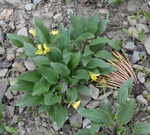
Violaceae: Viola nuttallii
Files
Family Name
Violaceae
Native American Name
Nuttall's violet, yellow prairie violet
Description
Viola nuttallii is a perennial, herbaceous, caulescent plant developing from a thick, vertical, woody rhizome that anchors a deep taproot system suited for arid prairie environments. The plant reaches a height of 2 to 27 cm and produces 1 to 6 ascending to erect stems that are characteristically about half-subterranean and covered in fine, short hairs. Leaf insertion is both basal (forming a minor rosette of 1 to 6 leaves) and cauline (alternate along the stems). The leaf type is simple, deeply green, measuring 2 to 10 cm in length and 0.5 to 3 cm in width, with a distinct lanceolate, elliptic, or narrowly ovate shape featuring an entire to finely irregular margin and lacking a notched base. Both the upper and lower leaf surfaces are typically glabrous to minutely puberulent, and the leaves are borne on long, minutely puberulent petioles measuring 2 to 17 cm long. Stipules are present and prominently adnate to the petiole, forming two linear-lanceolate wings with entire margins and free, acute, few-toothed apex tips. Flowering occurs early in the season, typically from April through July, with solitary, flowers arising from the upper leaf axils. The calyx consists of 5 free, green, lanceolate to linear-lanceolate sepals measuring 4 to 8 mm long and 1 to 2.5 mm wide, characterized by prominent, short basal auricles. The corolla is composed of 5 free petals that are deep yellow on the inside face but often tinged with brownish purple on the back; the two lateral petals are distinctly bearded with internal hairs, and the lowest three petals exhibit prominent brownish-purple nectar lines. The reproductive structures include 5 distinct stamens that are small, cream-colored, and tightly surrounding the ovary, with prominent dorsal appendages. The single pistil consists of a superior, 3-carpelled ovary topped by a curved style with a characteristically hairy, capitate style tip and an unspurred stigma opening. The fruit is an erect, dry, 3-valved, subglobose capsule measuring 6 to 9 mm long, which changes from pale green to tan or light brown upon reaching maturity between late June and August. The yellow prairie violet is native to South Dakota, where it can be found primarily across the western and central portions of the state, colonizing dry, open grasslands, sagebrush-steppe lands, and exposed bluffs.
Horticulture Notes
Seed Collection: Check capsules frequently in early summer as they transition from green to tan. Collect the pods just before they explosively dehisce to capture the smooth, brown seeds.
Seed Germination: Seeds require a period of cool, moist stratification for 60 to 90 days. They germinate best in cool temperatures (15 to 21°C). Best to fall sow, covering seeds to block light.
Vegetative Propagation: Propagated by carefully dividing the thick caudex or rhizome during its dormant period in the early autumn or early spring before active growth begins.
Soils: Well-drained soils, showing a strong preference for sandy, gravelly, or rocky substrates with a neutral to slightly alkaline pH.
Light: Full sun to light, open shade.
Water: It has low water needs and exceptional drought tolerance once established. It tolerates dry summer conditions but requires reliable moisture during its brief spring growing and flowering phase.
Additional Notes
Yellow prairie violet serves as an exceptional, drought-tolerant choice for native plant rock gardens or xeriscape borders, providing an early splash of vivid color right after the spring snowmelt. Ecologically, it is highly valued as a nectar source for early-emerging native bees and acts as a vital larval host plant for various prairie fritillary butterflies. Human use of the plant includes consumption of the raw leaves and flowers which are exceptionally rich in vitamins A and C, though care must be taken since the roots, fruits, and seeds are toxic.