

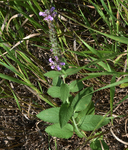
: Lamiaceae: Teucrium canadense
Files
Family Name
Lamiaceae
Common Name
American germander, Canada germander, wood sage, wild basil
Description
Teucrium canadense is a perennial, erect, herbaceous plant that spreads via an extensive system of slender, pale rhizomes coupled with fibrous roots. The plant typically reaches a height of 30 to 100 cm, featuring stout, unbranched or sparsely branched, square stems that are hollow and densely covered in downward-pointing or spreading hairs. Leaf insertion is opposite along the stem. The leaves are simple, lanceolate to ovate, medium-to-dark green above and paler beneath, measuring 5 to 13 cm long and 2 to 5 cm wide. The leaf margins are coarsely serrate. The upper leaf surface is finely pubescent to wrinkled, while the lower surface is densely covered in velvety, grayish-white hairs. The leaves have petioles measuring 0.5 to 1.5 cm in length. Flowering occurs from June through September, with the blossoms arranged in a dense, crowded, terminal spike-like raceme spanning 5 to 20 cm in length. The calyx is 5 to 7 mm long, composed of 5 fused sepals that form a bell-shaped tube with 5 unequal, short, triangular teeth; it is variable in color from light green to purplish-tinted and covered in sticky, glandular hairs. The corolla is 10 to 15 mm long and consists of 5 petals that are fused at the base but split into a highly irregular, bilaterally symmetrical configuration. The corolla upper lip is deeply cleft and reduced to two tiny lateral lobes. The lower lip is highly prominent, elongated, downward-projecting, pale pink to lavender-pink or purplish, often decorated with dark rose nectar guides. Emerging from the deep cleft of the reduced upper lip are 4 strongly arched stamens with slender, pinkish-white filaments that extend well beyond the corolla tube, terminating in tiny, orange-to-brown anthers. Nestled among the stamens is a single compound pistil with a deeply 4-lobed ovary, a long, slender, curving style, and a shortly two-cleft stigma. The fruit is a cluster of 4 small, dry, egg-shaped nutlets (schizocarp) that do not split open when ripe, each nutlet measuring about 2 mm long, finely wrinkled, tan to dark brown, and reaching full maturity from August through October. American germander is a native species in South Dakota, found statewide but occurring most frequently in the eastern and southern regions of the state; it primarily occupies moist-to-wet habitats including floodplains, wet prairies, marshes, ditches, stream banks, and damp woodland borders.
Horticulture Notes
Seed Collection: Collect the drying terminal flower spikes from late August through October; strip the mature, brown, papery calyces manually and crush them gently over screens to isolate the small, hard, tan nutlets.
Seed Germination: Seeds are dormant and require a period of cold, moist stratification. Fall sowing on the surface will generate good germination in the spring.
Vegetative Propagation: Easily propagated by dividing established rhizome clumps during the early spring or late autumn.
Soils: Prefers rich, fertile loams, silts, and mucky alluvial clays, but is highly adaptable to sandy or heavy clay substrates.
Light: Full sun to partial shade.
Water: High-to-moderate moisture levels, in poorly drained soils. Will endure brief periods of complete seasonal flooding or shallow standing water.
Additional Notes
American germander serves as an exceptional component for wetland restoration and stabilizing degraded shorelines, using its aggressive rhizomatous network to successfully bind loose, saturated soils against erosion. The uniquely two-lipped flowers offer a crucial nectar source for long-tongued insects, specifically attracting bumblebees, honeybees, digger bees, and clearwing hummingbird moths, alongside occasional visits from ruby-throated hummingbirds. While it is occasionally integrated into intentional rain gardens, native pollinator borders, and meadow landscapes for its robust summer color, it can become aggressive in moist garden settings and requires ample space to spread.