

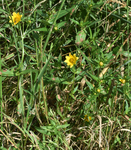
Asteraceae: Bidens cernua
Files
Family Name
Asteraceae
Common Name
Nodding beggarticks, nodding bur-marigold, sticktight
Native American Name
Lakota: mnióhuta aglágla, waȟčá zí
Description
Bidens cernua is an obligate, warm-season annual wetland herbaceous forb supported by a shallow taproot system that frequently develops fibrous adventitious roots at the lower stem nodes when submerged. It typically achieves a plant height of 10 to 100 cm at maturity, displaying prostrate to erect stems that are soft, light green to reddish-purple, mostly glabrous or sparsely rough-hairy, and often branched. The leaf insertion is opposite and sessile, with the bases of opposing leaves often fused directly around the stem. The simple leaves are light green to medium green, 4 to 20 cm in length and 5 to 45 mm in width, with a linear-lanceolate or lanceolate shape, acuminate tips, and coarsely serrate margins. Both the upper and lower leaf surfaces are smooth and glabrous to nearly glabrous. Flowering occurs from July to October. The inflorescence consists of solitary terminal heads or loose clusters born on peduncles 1 to 7 cm long. Individual heads are radiate or occasionally discoid, measuring 1.2 to 2.5 cm across, and typically droop or nod as they age. The hemispheric involucre features two distinct rows of dissimilar phyllaries: the outer series contains 5 to 9 leaf-like, linear-lanceolate bracts measuring 1 to 3 cm long that are widely spreading or reflexed, while the inner series contains 6 to 10 ovate-lanceolate bracts measuring 4 to 10 mm long with yellowish or clear scarious margins. The pappus consists of 4 straight awns measuring 2 to 4 millimeters long, which are lined with tiny, downward-pointing barbs. There are 6 to 8 yellow ray florets measuring 8 to 15 mm long (though sometimes absent) surrounding a dense central disk of numerous fertile yellow disk florets with corollas 3 to 4 mm long. The flowers possess 5 stamens featuring dark yellow to brownish linear anthers fused into a tube around the style. The single pistil contains a inferior ovary with a slender style that splits into 2 distinct, recurved stigmas. The fruit is a wedge-shaped, 4-angled, front-to-back compressed achene (cypsela) measuring 5 to 7 millimeters long, which turns dull dark brown to blackish purple. The achenes reach maturity from late August through October. Nodding beggarticks is native to South Dakota, where it can be found distributed across wet habitats statewide, including marshes, wet ditches, stream banks, lake edges, sedge meadows, and exposed mud flats.
Horticulture Notes
Seed Collection: Harvest nodding flower heads from late September through October when the achenes turn dark brown and separate easily from the receptacle. The barbed awns cause the seeds to stick aggressively to clothing and animal fur, so wearing protective gloves and utilizing canvas collection bags is recommended.
Seed Germination: Seeds require 60 to 90 days of cold, moist stratification to break dormancy. They germinate readily in the spring on exposed mud flats.
Vegetative Propagation: Can be propagated vegetatively during the early summer by taking stem cuttings that include the lower nodes. These cuttings root rapidly when placed directly in clean water or saturated, muddy potting media.
Soils: Rich organic mucks, silts, loams, and heavy clay soils. It has a high tolerance for anaerobic conditions and nutrient-enriched or trampled substrates.
Light: Full sun to partial shade.
Water: Requires constantly wet, saturated, or flooded conditions, demonstrating very high water use. It tolerates seasonal water fluctuations, high water tables, and shallow standing water up to 10 centimeters deep.
Additional Notes
Nodding beggarticks offers strong ecological value within wetland ecosystems by serving as a major late-season nectar source for native bees, wasps, flies, and butterflies, while its achenes are heavily consumed by waterfowl, marsh birds, and small rodents. The plant is well-suited for horticultural integration into rain gardens and naturalized wetland restorations where soil stays consistently saturated and seasonal color is desired. Historically, certain Indigenous groups utilized members of the genus Bidens to create natural yellow and orange textile dyes from the flower heads.