

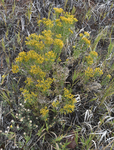
Asteraceae: Chrysothamnus viscidiflorus
Files
Family Name
Asteraceae
Common Name
Yellow rabbitbrush, green rabbitbrush
Description
Chrysothamnus viscidiflorus is a perennial, deciduous shrub that develops from a deeply penetrating taproot system connected to a branched, woody caudex; it features an aggressive root habit capable of sprouting when injured. The plant typically reaches a height of 10 to 120 cm. Its erect to spreading, brittle stems are highly branched from the base, showing a green, smooth, or puberulent surface when young that matures into a whitish-tan, gray, and ultimately flaky, fibrous bark. Leaves feature an alternate insertion pattern, are simple, sessile, and display a distinctive bright green to gray-green color. Individual blades are linear, oblong, or lanceolate, measuring 10 to 75 mm in length and 0.5 to 10 mm in width; they are frequently characteristically twisted, with flat to wavy margins, acute to apiculate apices, an evident midnerve, and surfaces that range from completely smooth (glabrous) to finely hairy or resin-dotted and sticky (viscid). Flowering occurs from July to September. The inflorescence consists of dense, flat-topped or rounded cyme-like clusters (panicles) of small, discoid heads elevated above the foliage. The flower head is subtended by a cylindrical to conicical involucre measuring 4 to 7 mm high and 1.5 to 2.5 mm wide, formed by approximately 15 yellow-green, sticky phyllaries (bracts) arranged in 3 to 7 overlapping series along 5 vertical to spiral ranks. The pappus consists of numerous white to tan, capillary bristles that equal or slightly exceed the corolla tube length. Each head contains 3 to 5 (rarely up to 14) golden-yellow, perfect disc florets with a corolla 3.5 to 7.5 mm long terminating in 5 small, spreading lobes measuring 0.7 to 1.7 mm. Inside the floret, there are 5 stamens featuring narrow, acute anther tips fused into a cylinder around the style. The single compound pistil features an inferior ovary, a long-exserted, slender style, and a pair of prominent, elongated stigma branches. The fruit is a dry, single-seeded cypsela (achene) measuring 3 to 5 mm in length, which is conic or cylindric, light brown, 5 to 10 ridged, and densely hairy. Fruits generally reach maturity between late August and October. Yellow rabbitbrush is native to South Dakota, where it is primarily localized within the western portion of the state, specifically throughout the dry foothills, grasslands, and rocky slopes of the Black Hills region.
Horticulture Notes
Seed Collection: Harvest seed heads in late autumn (October to November) when the achenes turn light brown and the capillary pappus bristles begin to expand and fluff out. Dry the collected material thoroughly in a well-ventilated space and separate the seeds from the chaff using fine-mesh screens. Store cleaned seeds in sealed, airtight containers at cool, dry temperatures.
Seed Germination: Seeds germinate readily; however, they benefit significantly from 30 to 60 days of cold, moist stratification at to maximize uniform emergence. Sow shallowly on the surface or under a very light layer of coarse medium, as light can enhance germination success.
Vegetative Propagation: Can be propagated via hardwood cuttings taken in late winter or semi-hardwood cuttings harvested in early summer. Treat cuttings with a rooting hormone (IBA) and maintain them under a mist system in a well-drained, sandy rooting medium until a robust root system establishes.
Soils: Prefers lightweight, well-drained sandy, gravelly, or rocky loams. Displays excellent tolerance for highly alkaline (pH up to 8.4), saline, and calcium-rich soils.
Light: Requires full, unobstructed sunlight.
Water: Very low water requirements once fully established, relying entirely on natural precipitation. It features excellent drought tolerance.
Additional Notes
Yellow rabbitbrush offers notable utility as an ornamental plant in xeric landscapes due to its exceptional drought tolerance, adaptability to poor alkaline soils, and vibrant late-summer golden blooms. Ecologically, the shrub serves as a vital structural component of western rangelands and the sagebrush steppe. It provides essential late season cover and critical forage for native wildlife, including pronghorn, mule deer, jackrabbits, and a wide array of native pollinators and insects. Because it is a vigorous pioneer species that resprouts reliably after low-severity wildfires and readily colonizes open ground, it plays an important role in soil stabilization and the natural reclamation of disturbed sites, abandoned mines, and eroded roadsides. Historically, indigenous peoples utilized the plant to produce bright yellow dyes from the flower heads and applied decoctions of the leaves and stems as traditional medicines to treat respiratory ailments and internal pain