

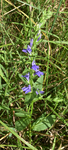
Campanulaceae: Lobelia siphilitica
Files
Family Name
Campanulaceae
Common Name
Great Blue Lobelia, Blue Cardinal Flower
Native American Name
Lakota: zuzéča tȟawóte, úma/uŋmá wápe tȟotȟó hé
Description
Lobelia siphilitica is a short-lived perennial herbaceous dicot that grows from a fibrous root system supported by short, offshoot-producing rhizomes or basal offsets. The plant reaches a height of 30 to 120 cm. Its stems are robust, erect, angular, unbranched (or occasionally weakly branched near the summit), and range from glabrous to slightly hairy along the ridges. Leaves feature re alternate, simple, light green to dark green, lance-shaped to oblong-ovate, up to 12.7 cm long and 3.8 cm wide. The leaf margins are finely to coarsely serrate or toothed, with an acute apex and a wedge-shaped base. The upper surface is mostly glabrous, while the lower surface displays light pubescence along the primary veins. Leaves are mostly sessile or possess a very short, winged petiole less than 0.5 inches long. Flowering occurs from July through October. The inflorescence forms a dense, terminal, spike-like raceme that ranges from 10 to 30 cm in length, packed with leafy bracts in the flower axils. The five green sepals are fused at the base into a short, ribbed hypanthium tube with free, linear-lanceolate, leaf-like lobes measuring 8 to 15 mm long and 2 to 3 mm wide, characterized by distinct auricles (ear-like appendages) at the sinuses. The corolla features five fused petals that form a two-lipped tube, 20 to 33 mm long; the upper lip consists of two small, erect, linear lobes, and the lower lip displays three prominent, spreading, ovate lobes. These petals are vibrant blue to lavender-blue (rarely white) with clear white stripes on the interior floor of the throat. The five stamens are fused by their filaments and steel-grey or bluish anthers into a curved tube roughly 10 to 15 mm long, forming a small melon-shaped sac suspended between the upper lobes. Inside this tube lies a single pistil featuring an inferior, two-celled ovary, a slender style, and a two-lobed stigma that pushes through the anther tube. The fruit matures from September to November as an ovoid, two-valved, papery dehiscent capsule roughly 6 to 10 mm long and wide. It splits open at the top to release hundreds of minute, oblong, golden-brown seeds. The great blue lobelia is native to South Dakota, occurring historically in the eastern half of the state (such as the Missouri River valley and eastern glaciated plains) within high-moisture ecosystems like wet meadows, stream margins, springs, and marshes.
Horticulture Notes
Seed Collection: Collect seed capsules in mid-to-late autumn when they turn tan and dry. Shake the minute, dust-like golden seeds into a paper bag; store them in a cool, dry, airtight container.
Seed Germination: Seeds require light to break dormancy. Sow them shallowly on the surface without covering in late fall. Spring planting requires seeds get a 60 day of cold, moist stratification before planting.
Vegetative Propagation: Divide established basal clumps or offsets in early spring.
Soils: Rich, humus-dense, fertile loams. It tolerates a wide textural variety including heavy clay, sandy loam, and silty soils.
Light: Full sun to partial shade. In hot climates or drier soils, afternoon dappled shade is recommended to protect foliage from scorching.
Water: Consistent moisture. It has low drought tolerance. It thrives in wet, saturated conditions and handles temporary seasonal flooding.
Additional Notes
Great blue lobelia is highly valued in horticulture for its late-summer sapphire blooms, making it an ideal choice for rain gardens, native borders, and shoreline stabilization. Ecologically, it provides high-quality nectar that attracts bumblebees, solitary bees, and butterflies, and its unique floral shape accommodates specialized long-tongued pollinators like hummingbirds