

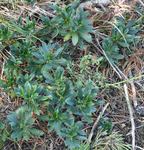
Ericaceae: Chimaphila umbellata
Files
Family Name
Ericaceae
Common Name
Pipsissewa, Prince's-Pine, Prince's Pine, Waxflower
Description
Taxonomic Description
Chimaphila umbellata is a slow-growing perennial subshrub or evergreen shrub that spreads via an extensive system of creeping underground rhizomes. The plant reaches a height of 10 to 35 cm, featuring woody, unbranched or sparsely branched, trailing vegetative stems. The leaves display a pseudo-whorled or sub-opposite leaf insertion along the stem. Each leaf is simple, sharply serrate or dentate along the margins, and oblanceolate to narrowly elliptic in shape. They exhibit a lustrous, dark green color on the upper surface and a noticeably paler green shade underneath. The blades range from 3 to 7 cm long and 0.5 to 2.5 cm wide, supported by short petioles measuring 3 to 10 mm in length. Flowering occurs in late summer, typically between June and August, via a terminal, nodding, umbel-like corymbose inflorescence that spans 2 to 5 cm across and bears 3 to 10 flowers. The flowers possess 5 free, persistent sepals that are broadly ovate to orbicular, roughly 1.5 to 2.5 mm long and wide, light green to pinkish, and have slightly erose margins. The 5 free, spreading to reflexed petals are orbicular, concave, about 5 to 7 mm long and wide, and are white to rosy-pink. Situated inside are 10 stamens, 2.5 to 3.5 mm long, with bi-poricidal violet-pink anthers and filaments that are distinctly dilated and hairy at their bases. The single, superior pistil features a large, globose, bright green ovary topped by a virtually nonexistent style and a broad, five-lobed, shield-shaped stigma. The resulting fruit is a dry, globose, 5-valved dehiscent capsule measuring 5 to 7 mm in diameter, which shifts from green to a dark brown color as it reaches maturity between August and October. Pipsissewa is native to South Dakota, where it is restricted to the western part of the state within the Black Hills region, specifically thriving in the deep shade and acidic organic litter of cool, dry coniferous forests.
Horticulture Notes
Seed Collection: Harvest the rounded, 5-valved capsules in late autumn (August through October) when they have turned completely brown but prior to splitting. Lightly tap or gently macerate the dried capsules inside a fine bag to extract the tiny, dust-like seeds.
Seed Germination: Germination from seed is notoriously difficult and carries a high failure rate under standard conditions. Seeds should be sown immediately after ripening directly into cold frames on wet sphagnum peat moss mixed with a small amount of parent-site forest soil to introduce native fungi. They require a long period of cold, moist stratification through winter. Successful germination is rare.
Vegetative Propagation: Propagate by carefully taking rhizome divisions or semi-hardwood stem cuttings during early spring as active growth resumes. It is critical to include a small amount of inoculated soil from around the mother plant to sustain vital mycorrhizal relationships. The root system is highly sensitive to disturbance making propagation difficult.
Soils: Requires rich, highly acidic, well-drained soils topped with an undisturbed, thick organic litter layer of decomposing pine needles or forest leaves.
Light: Partial to deep shade, making it strictly adapted to forest understories.
Water: Consistent, light moisture mimicking a damp woodland floor. Minimal tolerance for severe drought or prolonged soil waterlogging.
Additional Notes
Pipsissewa functions ecologically as an important groundcover in undisturbed forest ecosystems, where its extensive network of creeping rhizomes aids in soil aeration and stabilizes the organic litter layer. The nodding flowers offer a late-season pollen and nectar supply for native generalist woodland pollinators, primarily bumblebees and staphylinid beetles. Because it is a partial myco-heterotroph, the plant forms crucial subterranean relationships with forest mycorrhizal fungi to obtain extra nutrients. Beyond its ecological role, humans have traditionally utilized the roots and leaves of this species to brew herbal teas. Its aromatic extracts have been harvested commercially from the wild to serve as a flavoring agent in candies and soft drinks, most notably root beer.