

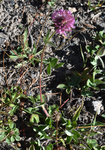
Fabaceae: Trifolium pratense
Files
Family Name
Fabaceae
Common Name
Red Clover, Purple Clover, Cowgrass
Native American Name
Lakota: blayé ziŋtká tȟačȟáŋ
Description
Trifolium pratense is a short-lived biennial or perennial herbaceous legume that develops a deep, branched taproot system. The plant reaches a height of 20 to 80 cm with erect to decumbent, multi-branched stems that are distinctly hairy to nearly hairless. The leaves are alternate and trifoliate. The leaflets are medium green, often marked with a distinctive pale green or whitish V-shaped crescent on the upper surface; each leaflet measures 1.5 to 4.5 cm long and 1 to 3 cm wide, varying in shape from ovate to elliptic. The upper surface is sparsely hairy, while the lower surface is more noticeably pubescent, particularly along the prominent veins. Long petioles are present, measuring 2 to 10 cm on lower leaves and becoming shorter or nearly absent near the top of the stem. Large, prominent stipules are present at the base of the petiole; they are ovate, up to 3 cm long, membranous, pale green with darker green or purple veining, and terminate in a sharp, bristle-like tip. Flowering occurs from May to September, producing a dense, globose to ovoid terminal inflorescence measuring 2 to 3.5 cm in diameter, which is usually closely subtended by a pair of reduced leaves. The calyx consists of 5 fused sepals forming a narrow, hair-fringed tube about 3 to 4 mm long with unequal, needle-like lobes (the lowest lobe being the longest at up to 4 mm); it is light green to reddish-purple. The corolla features 5 fused petals displaying the classic papilionaceous (pea-like) structure, measuring 12 to 15 mm long and ranging in color from deep pinkish purple to magenta. The androecium consists of 10 stamens that are diadelphous (9 fused into a tube surrounding the pistil and 1 free), featuring tiny, yellow anthers. The gynoecium contains 1 pistil with a superior, single-celled ovary, a slender style, and a small, capitate stigma. The fruit is a small, egg-shaped pod measuring 2 to 3 mm long that breaks open transversely to release a single, kidney-shaped seed shifting from yellow to purplish brown upon reaching maturity from July to October. Red clover is introduced and not native to South Dakota, it is originally native to Europe, Western Asia, and Northwest Africa but it is now naturalized widely across all counties of the state, thriving in pastures, agricultural fields, lawns, roadsides, and disturbed open areas.
Additional Notes
Red clover is highly valued ecologically and horticulturally as a premier cover crop and green manure due to its outstanding ability to fix atmospheric nitrogen through symbiotic root bacteria, drastically improving soil fertility and structure. It serves as a vital resource for pollinators, offering a copious supply of nectar and pollen that attracts long-tongued bumblebees and various butterflies, while its nutritious foliage provides high-quality forage for livestock and wild herbivores. For human use, the sweet, edible flower heads are frequently dried to brew traditional herbal teas.