

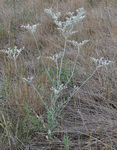
Polygonaceae : Eriogonum annuum
Files
Family Name
Polygonaceae
Common Name
Annual Buckwheat
Description
Eriogonum annuum is an annual to biennial herb with 1 to a few erect, simple to branched stems, 10-100 cm tall and covered with silver-gray hairs. The plants start with a few, short-lived, simple, oblanceolate basal leaves, 2-5 cm long. The alternate, petiolate cauline leaves appear similar to the basal leaves, with most of them toward the base of the stem. The inflorescence is a terminal cyme, often with smaller cymes at the ends of the lower branches. The open cymes have a helicoid, bi or trichotomous branching pattern. The flowers are subtended by a sessile, membranous, calyx-like involucres that are funnel-shaped, 2.5-3 mm long, with shallow teeth. The perianth is composed of 6 white segments, sometimes with a pinkish tinge, the insides are hairy and the outer members are wider than the inner ones. There are 9 stamens and a 3 styles. The fruit are smooth achenes. Annual wild buckwheat blooms from July into September on dry, open grasslands in western and southern South Dakota.
Horticulture Notes
Seed collection: Seeds are collected in late summer and fall.
Germination: Fall sowing is recommended but some seeds will germinate if planted in the spring.
Soils: Sandy to rocky dry soils.
Light: Full sun.
Water: Medium dry to dry.
Additional Notes
Annual wild buckwheat has a unique appearance and works well in xeriscape gardens. The plants reseed themselves and the flowers attract a wide variety of bumblebees. Of the many buckwheat species, it is probably the least utilized in horticulture.