

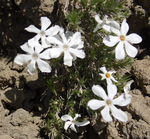
Polemoniaceae: Phlox hoodii
Files
Family Name
Polemoniaceae
Common Name
Hood’s phlox, carpet phlox, spiny phlox
Description
Phlox hoodii is a perennial, herbaceous plant forming dense, cushion-like mats or low tufts. It has a fibrous root system and may develop a woody base with age. Plants typically range from 2 to 10 cm tall. The stems are short, densely branched, and covered with stiff, spreading hairs, giving a somewhat spiny appearance. Leaves are opposite, linear to narrowly lanceolate, simple, and clustered along the stems. Leaf color is gray green to green; leaves are 4–10 mm long and 1–2 mm wide, with ciliate (hairy) margins and surfaces, and a sharp, pointed tip. The upper and lower leaf surfaces are similar, both bearing stiff hairs. Leaves are sessile. Flowering occurs early in the spring, usually from April to June, depending on elevation and latitude. The inflorescence consists of solitary flowers or small clusters at the ends of stems. Flowers have a tubular calyx about 5–8 mm long, with five fused sepals that are green and covered with spreading hairs and glandular tips. The corolla (petals) is salverform, with a narrow tube (10–18 mm long) abruptly spreading into five (6) lobes, each 5–10 mm long; petals are typically white, pink, or lavender. There are five stamens inserted at the mouth of the corolla tube, usually included, with slender white filaments and yellowish anthers. The pistil consists of a single style, 8–12 mm long, ending in a three-lobed stigma. Fruit is a small, ovoid capsule, about 3–4 mm long, that matures in late spring to early summer, turning brown at maturity and splitting to release seeds. Hood’s phlox is native to South Dakota and is found throughout the western and central parts of the state, especially in dry prairies, rocky outcrops, and open pine woodlands.
Horticulture Notes
Seed collection: Seeds mature late spring to early summer; collect capsules as they begin to turn brown and split.
Seed germination: Best sown outdoors in fall for natural stratification; artificial cold-moist stratification for 30–60 days can improve germination.
Vegetative propagation: Division of mature mats in early spring or late fall.
Soils: Prefers well-drained, sandy or gravelly soils; tolerates poor, rocky substrates.
Light: Full sun; tolerates some light shade but flowers best in open conditions.
Water: Very drought tolerant once established; avoid excessive moisture or poor drainage.
Additional Notes
Hood’s phlox is valued horticulturally for its early spring flowers and its ability to form attractive, drought-tolerant groundcover in rock gardens and xeriscapes. Ecologically, it provides early forage for pollinators such as bees and butterflies.