

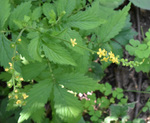
Rosaceae: Agrimonia striata
Files
Family Name
Rosaceae
Common Name
Roadside agrimony
Description
Agrimonia striata is a perennial herbaceous plant in the Rosaceae family, commonly known as roadside agrimony. It has a fibrous root system and does not reproduce asexually via stolons or rhizomes. The stems are upright, usually simple or occasionally sparingly branched, and range from 30 to 120 cm in height, with a covering of fine, soft hairs that give the young growth a slightly fuzzy texture. Leaves are alternate and pinnately compound, with 3–7 pairs of oblong-lanceolate, coarsely toothed leaflets, usually 3 to 8 centimeters long and 1 to 3 centimeters wide, with serrate margins and petioles approximately 1 to 3 centimeters long. The terminal leaflet being the largest; both basal and cauline leaves are present, with basal leaves forming a rosette and cauline leaves distributed along the stem. Inflorescences are slender, terminal racemes appearing from June to September. Each flower has five yellow petals about 2.5 to 4 millimeters long and 1.5 to 3 millimeters wide, and five green sepals with slender tips roughly 2 to 3 millimeters long. There are numerous stamens (20 or more) arranged around a superior ovary; filaments are slender and about 2 to 4 millimeters long with yellow anthers. The pistil consists of a single ovary , with 2–5 locules, a slender style terminating in a capitate stigma. Fruits mature into small, dry achenes covered with hooked bristles that aid in animal dispersal, turning brown at maturity in late summer or early fall and typically containing a single small, hard, dark brown seed. Roadside agrimony is native to South Dakota, found in moist meadows, woodland edges, thickets, and along riverbanks, and is distributed statewide, with higher abundance in the eastern regions and river corridors.
Horticulture Notes
Seed Collection: Seeds are mature when the burs turn brown and dry, usually in late summer to early fall. Mature fruits detach easily from the plant and may stick to fur or clothing due to their hooked bristles.
Germination: Seeds display physiological dormancy and benefit from cold, moist stratification for 2–3 months prior to spring sowing to improve germination rates.
Vegetative Propagation: Not commonly propagated asexually in cultivation; sexual reproduction by seed is the norm.
Soils: Prefers moist, well-drained soils but is adaptable to a range of soil types including clay and loam.
Light: Grows well in partial shade to full sun.
Water: Requires moderate moisture; tolerates occasional drought once established but thrives in consistent moisture
Additional Notes
Roadside agrimony, like other Agrimonia species, has been used traditionally in herbal medicine. It is not toxic to humans and is valued for its mild astringent properties. Ethnobotanical uses include treatment for digestive complaints, skin conditions, and as a mild tonic. The plant has also been used in dye production and, in some cultures, for hair care products. Its flowers attract native pollinators and provide benefits to many native insects.