

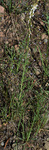
Brassicaceae: Arabis holboellii
Files
Family Name
Brassicaceae
Common Name
Holboell’s Rockcress, Reflexed Rockcress
Description
Arabis holboellii is a short-lived perennial or biennial herb. The plant forms a narrow taproot system. Stems are generally 15 to 40 centimeters tall, erect, slender and may be branched or unbranched and covered with fine, branched or 2-rayed hairs. Basal leaves are linear to spoon-shaped or narrowly oblanceolate, 1–5 cm long, with toothed margins and pointed tips, and are densely hairy. Cauline leaves are narrower, lance-shaped, and auriculate-clasping, also with fine hairs. Petioles are short (about 0.5 to 1.5 centimeters). Flowering occurs mid to late spring. The inflorescence is a raceme. Flowers have four sepals (2–4 mm, green or purplish), four petals (5–9 mm, white to purple), six stamens (anthers yellow), and a single compound pistil with a slender style and two-lobed stigma. The fruit is a slender, straight to slightly curved silique, 3–8 cm long, 1.5–2 mm wide, maturing in summer and turning brown. Each fruit contains numerous small, brown seeds. Holboell's Rockcress is native to South Dakota. It typically grows in open, rocky, or sandy soils, grasslands, prairies, and open woodlands, occurring statewide but more commonly in the western and central regions.
Synonym: Boechera holboellii
Horticulture Notes
Seed Collection: Collect seeds in late summer when the siliques (fruits) turn brown and begin to split open. The mature seeds are small and dark brown, easily shaken from the dry pods.
Germination: Seeds are best sown in the fall to allow natural stratification or can be sown in early spring after 30–60 days of cold-moist stratification. Germination is generally rapid under cool, moist conditions.
Vegetative Propagation: Not commonly propagated asexually; most propagation is by seed.
Soils: Prefers well-drained, sandy, gravelly, or rocky soils but tolerates a range of conditions, including clay-loam.
Light: Thrives in full sun but tolerates partial shade.
Water: Drought-tolerant; requires minimal water once established, but optimum growth occurs with occasional watering in dry periods.
Additional Notes
While specific traditional uses for Arabis holboellii are limited, members of the genus are sometimes used ornamentally for rock gardens and native plant landscaping. The plant supports native pollinators during its bloom