

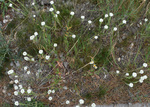
Brassicaceae: Berteroa incana
Files
Family Name
Brassicaceae
Common Name
Hoary Alyssum
Description
Berteroa incana is an annual or biennial herb with a taproot system, reproducing exclusively by seed. The plant has a simple to much-branched stem, 20–80 cm tall, covered throughout with dense, stellate (star-shaped), grayish-white hairs that give it a distinctive hoary or silvery appearance. Leaves are alternate, simple, lanceolate to oblong, 2–6 cm long, with entire margins and covered in soft, white hairs; the lower leaves are somewhat wider and may have short petioles, while upper leaves are narrower and sessile. Flowering occurs from late spring to summer, with racemes of small, four-petaled white flowers about 8 to 12 millimeters in diameter. Each flower has four white petals approximately 4 to 6 millimeters long and 2 to 3 millimeters wide and four green sepals about 3 to 5 millimeters long. Six stamens are present, with tetradynamous arrangement (four long, two short), featuring slender filaments and yellow anthers. The pistil consists of a single superior ovary with two fused carpels, a slender style, and a bifid stigma. Fruit is a flattened silicle, typically 1 to 1.5 centimeters long and about 5 to 8 millimeters wide, containing multiple small seeds arranged in two rows. Fruits mature in mid to late summer, turning from green to brown as it matures and splits open to release several small, brown, oval seeds. Hoary Alyssum is introduced and considered a noxious weed in South Dakota, particularly in disturbed soils, roadsides, pastures, and waste areas, and it occurs statewide but is most problematic in eastern and central regions.
Additional Notes
Berteroa incana is not used in horticulture and is considered an invasive noxious weed. It is of little value to native insects and is toxic to horses, causing lameness, fever, and, in severe cases, death if ingested in hay or forage.