

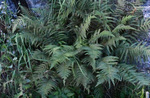
Athyriaceae: Athyrium filix-femina
Files
Family Name
Athyriaceae
Common Name
Lady Fern
Description
Athyrium filix-femina is a deciduous, perennial fern with a short, stout, creeping rhizome that forms dense clumps but does not spread aggressively. The fronds (leaves) are upright to arching, 0.5–1.2 meters tall, and bright green, with a delicate, lacy appearance; each frond is bipinnate to tripinnate (deeply divided), lance-shaped, and tapers at both ends. The leaf stalk (stipe) is grooved and covered with fine brown scales at the base. Leaflets (pinnae) are oblong-lanceolate, with deeply toothed segments; the overall texture is soft and feathery. Both fertile and sterile fronds are similar in appearance. The reproductive structures (sori) are small, curved, and arranged along the veins on the underside of the fronds, each covered by a thin, curved indusium. Reproduction is by spores, which mature from midsummer to early fall. The spores are released from the sori when mature, and the plant relies on wind for spore dispersal. Lady Fern is native and widespread in South Dakota, found in moist woods, streambanks, seeps, and shady canyons—most frequently in the Black Hills, Coteau des Prairies, and other mesic habitats statewide.
Horticulture Notes
Seed Collection: Spores are mature from midsummer to early fall when the sori turn brown and release fine, dust-like spores; collect by tapping fronds over a paper.
Germination: Sow spores on the surface of sterile, moist potting mix in a covered container; keep warm (15–20°C) and humid, as spores need light and moisture to germinate.
Vegetative Propagation: Clumps can be divided in early spring or fall, taking care to preserve rhizome segments with attached fronds.
Soils: Prefers rich, moist, well-drained soils high in organic matter; tolerates a range of soil types if moisture is adequate.
Light: Partial to full shade; tolerates filtered sun if soil stays moist.
Water: Requires consistently moist soil, especially during establishment; not drought-tolerant.
Additional Notes
Lady Fern is widely valued as an ornamental for shady gardens due to its graceful form and adaptability. While some Indigenous peoples used the young fiddleheads as a food source (cooked only, as raw fronds may be mildly toxic), and the rootstocks were sometimes used medicinally (as a poultice or decoction for wounds, stings, or sore throats), it is not a major food plant and caution is advised with consumption. The dense growth provides cover for small wildlife and is beneficial in restoration plantings for erosion control in moist, shaded sites.