

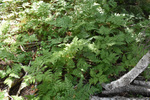
Dennstaedtiaceae: Pteridium aquilinum
Files
Family Name
Dennstaedtiaceae
Common Name
Bracken fern
Description
Pteridium aquilinumis a large, perennial fern spreading by extensive underground rhizomes and forming dense colonies. Fronds are alternate, compound, grow 50 to 150 cm tall, are triangular and deeply pinnatifid, with a leathery texture. Leaflets are lanceolate, typically 3–8 cm long and 1–3 cm wide, with serrated margins. Petioles (stipes) are erect, reddish-brown to dark brown. Length varies but can be up to 1 meter and are covered in fine hairs or scales near the base. The upper surface of the leaflets is medium green and smooth, while the lower surface is paler and bears sori (spore-producing structures) arranged in two rows along the underside of the pinnae margins. The sori are covered by indusia that are kidney-shaped, about 2–3 mm wide. The fern reproduces by spores released from mature sori, typically in late summer to early fall (August to October). Native to South Dakota, bracken fern primarily distributed in the Black Hills region in the western part of the state, thriving in a variety of habitats including woodlands, open fields, roadsides, and disturbed sites, often preferring acidic, well-drained soils.
Horticulture Notes
Spore Collection: Collect spore cases (sori) from the underside of fronds in late summer, drying them to release the dust-like spores.
Germination: Sprinkle the spores thinly over the surface of the moist, sterilized soil in a clear container. Seal the container to ensure high humidity, and place in a spot with indirect light (a north-facing windowsill is ideal). A temperature range of 18−22∘C is ideal. Within a few weeks to two months, a green, moss-like film (prothallia) will cover the soil. These are not yet true ferns but contain the reproductive organs. Once small, true fronds appear from the prothallia, they can be transplanted into small pots, though this process is slow.
Vegetative Propagation: Division of rhizomes.
Soils: Prefers well-drained, acidic to neutral soils.
Light: Full sun to partial shade.
Water: Prefers moderate moisture; tolerant of dry conditions once established.
Additional Notes
Bracken fern fiddleheads have been used traditionally for food (after careful preparation to remove toxins) and for medicinal purposes by some Native American groups. Ecologically, it provides ground cover that stabilizes soil and offers habitat for wildlife. In horticulture, it is sometimes used as an ornamental fern for shade gardens but can be invasive.