

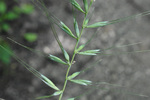
Poaceae: Brachyelytrum erectum
Files
Family Name
Poaceae
Common Name
Bearded Shorthusk
Description
Brachyelytrum erectum is a perennial, tufted grass with a short, fibrous root system and sometimes creeping rhizomes, though it rarely forms dense colonies. The plant has upright to arching, slender stems (culms) that are typically unbranched, growing 40–100 cm tall. Leaf blades are alternate, thin, flat, and softly hairy, 10–30 cm long and 0.5–2 cm wide, tapering to a pointed tip, with margins that may be rough to the touch. The leaf sheath is open, and the ligule is a short fringe of hairs. The inflorescence is a narrow, nodding panicle (spike-like in appearance), 5–15 cm long, with few to several spikelets. Spikelets are one-flowered, about 1–1.5 cm long, with a long, straight or slightly bent awn extending from the lemma. The fruit is a small, brown, dry caryopsis (grain) about 3–5 mm long, maturing in late summer. Bearded Shorthusk is native to South Dakota, generally found in rich, moist to mesic deciduous woods, shaded slopes, and streambanks, especially in the eastern and central regions.
Horticulture Notes
Seed Collection: Collect seeds in late summer to early fall when spikelets and grains are dry and brown; grains are easily separated by gently stripping the inflorescence.
Germination: Sow seeds in fall or after 60 days of cold-moist stratification; germination occurs in spring under moist, cool conditions.
Vegetative Propagation: Can be divided in early spring, but is slow to establish from divisions.
Soils: Prefers moist, rich loams or sandy loams; tolerates a range of woodland soils if drainage is adequate.
Light: Best in partial to full shade; tolerates light sun in moist soils.
Water: Requires consistent moisture, especially when young; established plants can tolerate some dry periods but grow best in mesic conditions.
Additional Notes
Bearded Shorthusk has limited horticultural use, but it is valued in naturalistic plantings for woodland restoration and as a component of native shade grass mixes. It provides cover and nesting material for small animals and birds, and foliage is occasionally browsed by deer.