

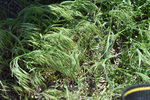
Poaceae: Bromus tectorum
Files
Family Name
Poaceae
Common Name
Cheatgrass, Downy Brome
Description
Bromus tectorum is an annual grass with a fibrous root system that often penetrates deeply into the soil, reproducing solely by seed. The culms (stems) are slender, erect to ascending, and typically 20–70 cm tall, often loosely tufted and branching only at the base. The plant is densely covered in soft, fine hairs, giving it a downy texture throughout. Leaf blades are alternate, linear, 5–20 cm long and 2–5 mm wide, flat or loosely folded, and also softly hairy. Sheaths are open and hairy, with a membranous, notched ligule at the base of each blade. Flowering occurs in the late spring to early summer. The inflorescence is a loose, nodding panicle 7–20 cm long, often purplish at flowering, with slender, drooping branches. Spikelets are 1.5–3 cm long (excluding awns), each with 5–8 florets. Each floret has a lemma with a long, straight awn (10–15 mm) that becomes conspicuously sharp and barbed at maturity. The fruit is a slender, brown caryopsis (grain), maturing in early to mid-summer. Cheatgrass is introduced and invasive in South Dakota, rapidly colonizing disturbed ground, pastures, rangelands, roadsides, and open woods, found statewide but especially abundant in dry, open sites.
Additional Notes
Cheatgrass is not valued in horticulture and is considered a highly problematic noxious weed. It provides little forage value and can be dangerous to livestock, as the mature seeds and awns can injure the mouths and digestive tracts of animals. Bromus tectorum is notorious for increasing wildfire frequency and severity in arid and semiarid regions, outcompeting native plants and altering ecosystem structure