

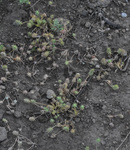
Ranunculaceae: Ceratocephala testiculata
Files
Family Name
Ranunculaceae
Common Name
Bur buttercup, curveseed butterwort
Description
Ceratocephala testiculata is a small annual herb growing from a slender, often shallow, fibrous root system. The entire plant is usually less than 5–10 cm tall. Stems are typically branched at the base, sparsely hairy to nearly glabrous, and not woody. Leaves are all basal, forming a loose rosette, deeply divided into narrow linear to lobed segments. Basal leaves can reach up to about 6–12 cm long, though each leaflet segment is quite narrow, usually 1–3 mm wide. The leaves are covered with short, stiff hairs. Flowering occurs very early in the spring (often March–April). Flowers are solitary or in small clusters, each about 5–10 mm across. Each flower has 5 yellow, shiny, oblong petals, rounded to slightly obovate in shape, about 5–8 mm long and 3–5 mm wide, giving the flower a compact appearance and 5 shorter, green sepals, typically about 3–5 mm long and approximately 1.5–2 mm wide. The sepals are somewhat ovate to lanceolate in shape and slightly pointed at the tip. Flowers contain numerous stamens and several pistils. The fruit is a small, spiny bur composed of a cluster of nutlets—each nutlet is ovoid, 3–5 mm long, armed with hooked or curved projections. Bur buttercup matures and sets seed rapidly—often by late spring or early summer. Seeds are small, yellowish or brown, and equipped for dispersal by animals via the hooked spines. Bur buttercup is an introduced species and is now a widespread weed in South Dakota, most common in dry, disturbed grasslands, roadsides, overgrazed pastures, sandy sites, and compacted soils, especially in the western part of the state.
Additional Notes
Bur buttercup is considered a noxious weed and is not used in horticulture. It is toxic to humans and livestock due to the presence of protoanemonin—a toxic compound in fresh plant material. All plant parts should be considered potentially harmful.