

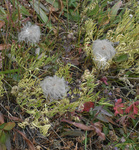
Ranunculaceae: Clematis hirsutissima
Files
Family Name
Ranunculaceae
Common Name
Sugarbowl, hairy clematis
Description
Clematis hirsutissima is a perennial herbaceous plant (subshrub) in the Ranunculaceae family. It grows from a deep, woody, branching taproot and sometimes a short, thick rhizome, but does not spread aggressively by vegetative means. Stems are simple to sparsely branched, erect or arching, 15–40 cm tall, and densely covered with stiff, spreading hairs (hirsute). Leaves are opposite and compound or deeply divided, with 3 (up to 9) linear to narrowly lanceolate segments per leaf, with each leaflet being ovate to lanceolate, 3–7 cm long and 1–3 cm wide, with entire to slightly toothed margins and densely hairy surfaces. The basal leaves may be larger and more numerous in a clump. Flowering occurs from May to July. Each plant produces one to several solitary, nodding, urn-shaped flowers atop long, hairy stalks. The flowers are bisexual, with 4 blue to purple, sometimes pink-tinged, thick, leathery sepals (petaloid in appearance), with four thick, petal-like sepals (clematis flowers do not have true petals) that are lavender to pale blue or purple with darker veins and covered with fine hairs on both surfaces. The sepals are broadly ovate to lanceolate, measuring approximately 2.5–4 cm long and 1–2 cm wide, sometimes slightly reflexed at the tips. Flowers contain numerous stamens (yellowish filaments with white anthers) and many separate pistils. The fruit is a cluster of numerous achenes, each bearing a long, plumose, feathery tail (up to 3 cm), initially silvery and maturing to tan, aiding in wind dispersal. Seeds ripen from midsummer to early fall. Sugarbowl is native to South Dakota, especially common in western parts of the state—the Black Hills, Pine Ridge, and rocky uplands. It occurs in dry hillsides, open pine woodlands, prairie bluffs, and rocky outcrops.
Horticulture Notes
Seed Collection: Seeds are mature in late summer when the feathery achenes dry, separate easily, and are buff-colored.
Germination: Fresh seed benefits from cold stratification (60–90 days). Sow outdoors in fall or stratify before spring sowing; some seeds may require a full year to germinate.
Vegetative Propagation: May be propagated by division of taprooted clumps or by rooting softwood cuttings in early summer.
Soils: Prefers well-drained, sandy or gravelly soils; tolerates nutrient-poor and rocky substrates.
Light: Thrives in full sun to light shade.
Water: Drought-tolerant; requires minimal watering once established, but consistent moisture in spring aids establishment.
Additional Notes
Sugarbowl is native and valued as an ornamental wildflower, well-suited for xeriscape gardens thanks to its drought and cold tolerance. It provides nectar and pollen for native bees and supports some lacewing and butterfly larvae.