

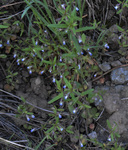
Scrophulariaceae: Collinsia parviflora
Files
Family Name
Scrophulariaceae
Common Name
Small-flowered blue-eyed Mary
Description
Collinsia parviflora is an annual or annual-biennial herb growing from a fibrous root system. The plant usually reaches 10–40 cm in height, with slender, erect, and often branched stems that can be smooth or sparsely hairy. Leaves are opposite, simple, ovate to lanceolate, typically 1–4 cm long and 0.5–1.5 cm wide, with entire or slightly toothed margins and a slightly hairy surface. Flowering occurs from late spring through summer (May–August). Inflorescences are dense terminal racemes or spikes with small, two-lipped flowers about 5–8 mm long. Flowers are typically pale blue to lavender, sometimes with darker markings or white areas on the lower lip. The sepals are fused into a tubular calyx approximately 3–5 mm long and 1.5–2 mm wide at the widest part. The calyx ends in five narrow, pointed lobes each about 1–2 mm long. The is tubular corolla has 5 lobes forming the two distinct lips, measuring about 6–10 mm long and approximately 3–5 mm wide at the expanded lower lip. The upper lip is divided into two small lobes about 1–2 mm long, while the lower lip has three broader lobes approximately 2–4 mm long and 2–3 mm wide. There are 2 stamens and a single pistil. The fruit is a small, round capsule (2–3 mm), maturing in midsummer, containing several tiny seeds. Small-flowered blue-eyed Mary is native to South Dakota and commonly found in open woodlands, grasslands, dry slopes, and disturbed areas, especially in upland and foothill regions statewide.
Horticulture Notes
Seed Collection: Seeds are mature when capsules dry and begin to open, typically in midsummer.
Germination: Seeds germinate easily without pretreatments; sow in fall or spring in well-drained soils.
Vegetative Propagation: Not propagated vegetatively; grows readily from seed.
Soils: Prefers well-drained soils, including sandy or rocky substrates.
Light: Grows best in full sun to light shade.
Water: Requires moderate moisture during growth but tolerates short dry periods.
Additional Notes
Small-flowered blue-eyed Mary is native to South Dakota and valued as a wildflower in naturalistic and restoration plantings. It provides early-season nectar for native bees and other pollinators.