

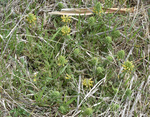
Scrophulariaceae: Pedicularis canadensis
Files
Family Name
Scrophulariaceae (Orobanchaceae)
Common Name
Canadian lousewort, wood betony
Description
Pedicularis canadensis is a perennial herb growing 15 to 50 cm tall from a fibrous root system, sometimes stoloniferous. The leaves are chiefly basal and petiolate, with petioles 5 to 15 cm long. Each leaf is pinnately compound with 7 to 15 lanceolate to oblong leaflets, each 2 to 5 cm long and 0.5 to 1.5 cm wide, with serrate margins and a slightly hairy surface. The upper leaves are progressively reduced, becoming nearly sessile. The erect flowering stems bear dense spikes of tubular, bilaterally symmetrical flowers blooming from May through July. Each flower has five green, lanceolate sepals about 5 to 7 mm long and 1.5 to 2.5 mm wide. The corolla is creamy white to pale yellow, about 15 to 20 mm long and 6 to 8 mm wide, with an upper curved lip forming a hood and a lower lip with three lobes. The flower contains four stamens with two long and two short filaments, and the anthers are fused into a tube surrounding the style. The pistil has a superior ovary with a style about 7 to 9 mm long, ending in a bifid stigma. Fruits develop from June through August, maturing into ovoid capsules 8 to 12 mm long and 3 to 5 mm wide, which split open to release numerous small seeds. Canadian lousewort is native to South Dakota, found primarily in the eastern and central parts of the state growing in prairies, open woodlands, and sandy or rocky soils.
Horticulture Notes
Seed Collection: Collect mature capsules in summer before dehiscence.
Germination: Seeds require light for germination and need cold stratification for 30–60 days at 33-38°F; or sow in fall on the surface of moist soil. Planting near established native grasses and sedges aids in establishment.
Vegetative Propagation: Possible from root division but less common.
Soils: Prefers well-drained, loamy soils with some organic matter.
Light: Full sun to partial shade.
Additional Notes
Wood betony is hemiparasitic, often attaching to roots of neighboring plants to obtain nutrients, which can influence plant community dynamics. It has been used traditionally by Native Americans for medicinal purposes including as a muscle relaxant and analgesic.