

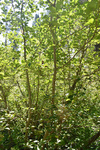
Rosaceae: Crataegus douglasii
Files
Family Name
Rosaceae
Common Name
Black hawthorn
Native American Name
Lakota: matȟó tȟaspáŋ, tȟaspáŋ hú
Description
Crataegus douglasii is a deciduous shrub or small tree with a deep, extensive root system and may form dense thickets by root suckering. Stems are erect, often branched, reaching heights of 3–8 meters. The bark is smooth and gray on young stems, becoming rougher and fissured with maturity. Leaves are alternate, simple, ovate to oblong, generally 3 to 8 centimeters long and 2 to 5 centimeters wide, with finely serrate margins and petioles about 1 to 2.5 centimeters long. Flowering occurs from May to June, producing clusters of white flowers about 1.5 to 2 centimeters in diameter. Each flower has five petals approximately 5 to 8 millimeters long and wide, and five greenish sepals about 2 to 4 millimeters long and 1 to 2 millimeters wide. There are typically 20 to 25 stamens inserted around a superior ovary, with filaments about 4 to 6 millimeters long and yellow anthers. The pistil consists of a single ovary with a short style and a lobed stigma. The fruit is a pome, rounded to slightly flattened, about 10 to 15 millimeters in diameter, dark purple to nearly black when mature, ripening in late summer to early fall. Black hawthorn is native to western North America and can be found in South Dakota, primarily in riparian woodlands, foothills, and open forests.
Horticulture Notes
Seed Collection: Fruits are mature when deeply colored black or purple and soft, typically in early fall; fruits can be harvested and seeds extracted by fermentation or maceration.
Germination: Seeds require cold stratification for 90–120 days and may benefit from scarification; sow in fall or after stratification before spring planting.
Vegetative Propagation: Can be propagated through root cuttings, grafting, or hardwood cuttings.
Soils: Prefers moist, well-drained soils, tolerant of clay and loam, and can grow in rocky uplands.
Light: Thrives in full sun to partial shade.
Water: Prefers moderate moisture but is drought-tolerant once established.
Additional Notes
Black hawthorn is valued for erosion control and wildlife habitat, providing nutritious fruits favored by birds and mammals. The dense, thorny branches make excellent cover and nesting sites. The fruits are edible and were sometimes used as food, natural dyes and for medicinal purposes by Indigenous peoples. The wood is hard and occasionally used for small tools.