

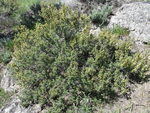
Rosaceae: Purshia tridentata
Files
Family Name
Rosaceae
Common Name
Antelope bitterbrush
Description
Purshia tridentata is a deciduous, woody shrub growing 1 to 3 meters tall with multiple slender, erect branches arising from a deep root system. The leaves are alternate and simple, measuring 1 to 3 cm long and 0.5 to 1.5 cm wide, with three distinct, obovate to spatulate lobes. The upper leaf surface is dark green and smooth, while the lower surface is lighter green and often covered with fine hairs giving a slightly fuzzy texture. Leaves are borne on petioles 2–5 mm long. The inflorescence consists of solitary flowers or small clusters born in leaf axils, blooming from April through June. The calyx comprises five small, narrowly triangular sepals about 3 to 5 mm long. The flowers have five pale to bright yellow petals each 10–15 mm long and slightly clawed at the base and are often fragrant. Stamens number about 15–30, inserted around the base of the ovary in a circle. The style is slender and elongated, ending in a small, rounded stigma. Fruits are achenes with a long, slender, beak-like tip, enclosed in a dry, papery cup or calyx. They mature from August through September. Rare but native in South Dakota, antelope bitterbrush occurs primarily in dry, rocky, and open shrublands in the southern Black Hills.
Horticulture Notes
Germination: Seeds germinate best after 2–7 weeks of cold-moist stratification at 2–5∘C. They are best sown in late fall or early winter to allow for natural chilling, at a depth of roughly 1-2 cm.
Vegetative Propagation: Can be propagated from semi-hardwood cuttings.
Soils: Prefers well-drained, sandy or rocky soils.
Light: Full sun.
Water: Drought tolerant once established; prefers dry to moderate moisture.
Additional Notes
Antelope bitterbrush is an important browse plant for wildlife such as deer and antelope. It is valued in restoration and erosion control projects for its deep roots and drought tolerance. The shrub is also used ornamentally for xeriscaping.