

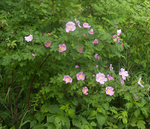
Rosaceae: Rosa woodsii
Family Name
Rosaceae
Common Name
Woods’ rose, wild rose, Western wild rose
Native American Name
Lakota: uŋžíŋžiŋtka hú
Description
Rosa woodsii is a perennial, deciduous shrub. It typically forms upright to arching thickets and grows from a fibrous root system with extensive rhizomes, allowing it to spread vegetatively. Plants usually reach 0.5 to 2 meters in height. Stems are slender, brown to reddish, and armed with straight or slightly curved prickles of variable size. New stems are often hairy. Leaves are alternate, pinnately compound, usually with 5 to 9 leaflets. Leaflets are oblong to elliptic, 1–4 cm long and 0.5–2 cm wide, with sharply serrated margins. The upper surface is dull green and glabrous to sparsely hairy, while the lower surface may have fine hairs. A short petiole (up to 2 cm) is present, often glandular and hairy, with prominent, persistent stipules at the base that are broad, flat, and fused to the petiole for much of their length. Flowering occurs from May to July. Inflorescences are solitary or in small corymbs at the end of branches. Each flower is 3–5 cm across, with five free, green sepals (1–2 cm long, narrowly lanceolate, and sometimes glandular on the back) that are often persistent on the fruit. There are five pink petals, rounded and spreading, 1–2 cm long, notched at the tip. Numerous stamens (typically over 50) form a ring around the pistils, with yellow filaments and anthers. The pistils are numerous, each with a short style, enclosed within the hypanthium (floral cup). The fruit is a fleshy, bright red to orange, ovoid to globose hip, 1–2 cm in diameter, maturing from August to October. The hips persist into winter and provide an important food source for wildlife. Woods’ rose is native to South Dakota and occurs across the state in a wide range of habitats, including prairies, streambanks, woodland edges, and open forests.
Horticulture Notes
Seed collection: Collect hips in late summer to fall; clean seeds from pulp before storage.
Seed germination: Seeds require cold-moist stratification for 60–120 days for best germination.
Vegetative propagation: Easily propagated by division of rhizomes or stem cuttings.
Soils: Grows in a variety of soils, from sandy to clay; prefers well-drained soils.
Light: Full sun to partial shade.
Water: Moderately drought tolerant but prefers moist, well-drained sites; tolerates periodic flooding.
Additional Notes
Woods’ rose is valued horticulturally for its hardiness, attractive flowers, and wildlife-friendly hips. It is used in habitat restoration and erosion control. Ecologically, it provides cover and food for birds and mammals, and its flowers attract pollinators. The hips are edible and high in vitamin C, and Native Americans have used them for food and tea, as well as traditional medicines.