

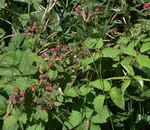
Rosaceae: Rubus occidentalis
Files
Family Name
Rosaceae
Common Name
Black raspberry
Native American Name
Lakota: tȟakȟáŋhečala hú
Description
Rubus occidentalis is a deciduous, woody bramble that forms arching or trailing canes up to 1.5–3 meters long. The canes are biennial, with first-year primocanes typically green and covered in fine hairs and sparse prickles, and second-year floricanes are brown, woody and more heavily armed with curved prickles. They usually die following fruit ripening. Leaves are alternate and compound, usually with three to five leaflets. Leaflets are ovate to lanceolate, 3 to 8 cm long and 2 to 5 cm wide, with serrated margins and pointed tips. The upper surface of the leaflets is dark green and slightly hairy; the underside is lighter green and more densely hairy. Petioles are 1 to 3 cm long. The inflorescence is a loose cluster of white to pale pink flowers blooming from May through July. Flowers have five broadly ovate petals, 10 to 15 mm long and 8 to 12 mm wide. The calyx consists of five ovate sepals, 5 to 8 mm long and 3 to 5 mm wide, often hairy on the outer surface. Each flower contains numerous stamens, typically 30 to 50, with filaments about 2 to 3 mm long and yellow anthers approximately 1 to 2 mm long. The pistils number 20 to 40 per flower, each slender, 2 to 3 mm long, tapering to a pointed stigma. Fruits mature from July through August as aggregate drupes about 1 to 1.5 cm in diameter, glossy black when ripe, each composed of multiple small drupelets. Black raspberry is native to South Dakota, and grows in open woods, forest edges, thickets, and disturbed sites, scattered throughout the eastern and southern parts of the state.
Horticulture Notes
Seed Collection: Collect ripe berries in summer; seeds can be extracted by washing mashed fruit.
Germination: Seeds benefit from cold stratification; sow in well-drained soil.
Vegetative Propagation: Propagated through root suckers or tip layering. (First-year canes (primocanes) bend to the ground in late summer and root at the tips. This natural process can be managed by burying cane tips in soil or pots, which develop roots and new shoots within 3–4 weeks.)
Soils: Prefers well-drained, loamy soils.
Light: Full sun to partial shade.
Water: Prefers moderate moisture; avoid waterlogged conditions.
Additional Notes
Black raspberry produces flavorful edible fruits prized for fresh eating, jams, jellies, and desserts. It also provides food and habitat for wildlife. The plant is cultivated commercially and in home gardens for its fruit.