

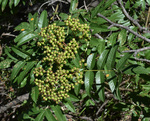
Rosaceae: Sorbus scopulina
Files
Family Name
Rosaceae
Common Name
Greene’s mountain-ash, mountain ash
Description
Sorbus scopulina is a perennial, deciduous shrub or small tree with a woody and fibrous root system. Mature plants are typically multi-stemmed and reach 2–6 meters in height. Stems are upright, slender, and brown to grayish, with smooth bark on young stems aging to slightly roughened with lenticels. Leaves are alternate, pinnately compound, 10–20 cm long, with 9–15 lanceolate to oblong leaflets per leaf. Each leaflet is 2–7 cm long and 0.7–2 cm wide, with serrated margins, a pointed tip, and a rounded or slightly tapered base; upper surfaces are dark green and glabrous, while lower surfaces are paler and may have sparse hairs, especially along the midrib. Petioles are present, 2–5 cm long, and leaf rachises may be slightly hairy. Flowering occurs from May to July, with dense, flat-topped corymbs 5–12 cm across, each bearing dozens of small, white, five-petaled flowers. The calyx has five small, green, triangular sepals, 1–2 mm long and 1 mm wide, fused at the base and persistent in fruit. Petals are five, white, oblong to ovate, 3–5 mm long and 2–3 mm wide, free and spreading. Each flower has 15–20 stamens with yellow anthers about 1.5 mm long. The pistil is compound (inferior ovary), formed by 3–5 united carpels, with 3–5 styles (sometimes fused at the base) and capitate stigmas. The fruit is a small, round pome, 6–10 mm in diameter, bright red to orange-red when mature in late summer to early fall (August–September). Greene’s mountain-ash is native to the Black Hills and western regions of South Dakota, where it inhabits moist forests, stream banks, canyons, and mountain slopes, typically in partial shade and well-drained soils.
Horticulture Notes
Seed collection: Collect fruits in late summer to early fall when fully colored; extract and clean seeds from ripe pomes.
Germination: Seeds exhibit dormancy and require cold stratification (60–120 days) to break dormancy and germinate. Fall planting works well.
Vegetative propagation: Propagated by softwood cuttings or layering, though seed propagation is most common.
Soils: Prefers moist, well-drained, loamy soils; tolerates a range of soils if moisture is adequate.
Light: Grows best in partial shade but tolerates full sun in cooler climates.
Water: Prefers moderate to moist conditions and does not tolerate prolonged drought.
Additional Notes
Greene’s mountain-ash is valued horticulturally for its attractive foliage, clusters of white flowers, and bright red fruit, which provide visual interest and wildlife attraction in landscape plantings. Ecologically, it serves as a food source for birds and mammals, especially in late summer and fall, and its flowers provide nectar and pollen for various insects. The fruit has been used in making jellies and preserves, though it is astringent and best after frost. It is planted in natural restoration projects, wildlife habitat enhancement, and as a shade or ornamental tree in landscaping.