

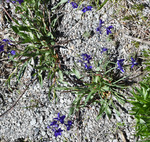
Ranunculaceae: Delphinium bicolor
Files
Family Name
Ranunculaceae
Common Name
Two-color larkspur
Description
Delphinium bicolor is a perennial herb typically growing from a fleshy, branching rootstock, stems are mostly smooth, 30 to 90 centimeters tall, erect and branched. Leaves are alternate, 4 to 12 cm long, palmately divided with 3 to 5 deeply cleft lobes. Each leaflet is ovate to lanceolate, typically 3–7 cm long and 2–5 cm wide, with coarsely toothed margins, a smooth texture, and a petiole 3 to 7 cm long. Flowering occurs from May to July, producing tall racemes of striking bicolored flowers, usually deep blue to violet with white centers. Flowers have five sepals; the posterior sepal is enlarged, forming a prominent backward-pointing spur about 1–1.5 cm long and 3–4 mm wide at the base, the lateral sepals are smaller and differently shaped. The petals number five, with two often highly modified. The upper two petals are typically white or pale, while the lower three are blue or violet, roughly 8 to 12 millimeters long and 4 to 6 millimeters wide. There are numerous stamens arranged around the carpels, inserted at the base of the petals, each filament is slender and about 5 to 8 millimeters long. The pistil consists of multiple carpels, each with a distinct style ending in a small, rounded stigma. The fruit is a cluster of dry follicles (several follicles per flower), each follicle is about 10 to 20 millimeters long, containing several small seeds that mature from late summer through early fall. Two-color larkspur is native to South Dakota, commonly found in open forests, grasslands, and rocky slopes, mainly in western and central regions in moist meadows, open coniferous forests, and montane slopes.
Horticulture Notes
Seed Collection: Seeds mature as follicles dry and split open, usually in midsummer; collect when seeds are dark and hard.
Germination: Seeds require cold stratification (30–60 days) to break dormancy; sow in fall or stratify before spring sowing.
Vegetative Propagation: Not commonly propagated vegetatively; mainly grown from seed.
Soils: Prefers well-drained, sandy or rocky soils.
Light: Thrives in full sun to partial shade.
Water: Tolerates dry to moderately moist conditions; drought-tolerant once established.
Additional Notes
While beautiful and valuable for native pollinators such as bees and hummingbirds, Delphinium bicolor is toxic to livestock and humans if ingested, so caution is advised. It adds vivid color to native wildflower gardens and restoration projects.