

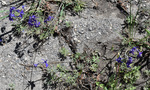
Ranunculaceae: Delphinium nuttallianum
Files
Family Name
Ranunculaceae
Common Name
Nuttall’s larkspur
Description
Delphinium nuttallianum is a perennial herb growing 20 to 70 centimeters tall with erect, slender stems. The stems are mostly glabrous or sparsely covered with fine hairs. Leaves are primarily basal, typically 3 to 8 cm long with petioles from 2 to 6 cm in length. They are deeply palmately divided into 3–7 narrow, lanceolate lobes, each about 1–4 cm long, with serrated margins; cauline leaves are fewer, smaller, and simpler. Flowering occurs from May to July. Flowers grow in slender racemes with numerous blue to pale violet, zygomorphic blossoms, often with a slate-gray tint. Each flower has five sepals (one forming a backward-spurred projection 1–2 cm long), four petals (two modified as nectar spurs), numerous stamens, and a single pistil. two upper petals often pale or white and the lower petals that are blue, each petal approximately 7 to 12 millimeters long and 4 to 6 millimeters wide, often bearded. Stamens are numerous, arranged in a ring around the carpels, with filaments about 4 to 6 millimeters long. The pistil consists of several free carpels (apocarpous), each with a slender style ending in a small, rounded stigma. The fruit is a cluster of several dry follicles, each follicle about 10 to 18 millimeters long, containing small seeds. Fruits mature from late summer to early fall. Nuttall’s larkspur is native to South Dakota, commonly found in dry meadows, open woodlands, rocky slopes, and foothills, especially in the western Black Hills and adjacent upland regions.
Horticulture Notes
Seed Collection: Seeds mature when dry follicles split open in mid to late summer; seeds should be collected when dark and firm.
Germination: Requires cold stratification (30–60 days) to break dormancy; best sown in fall or pre-stratified for spring planting.
Vegetative Propagation: Not commonly propagated vegetatively; typically grown from seed.
Soils: Prefers well-drained, sandy to rocky soils.
Light: Grows best in full sun to partial shade.
Water: Tolerates dry to moderate moisture; drought resistance improves with maturity.
Additional Notes
Nuttall’s larkspur is valued for its attractive inflorescences and is used in wildflower seed mixes and natural landscaping to support native pollinators such as hummingbirds, bees and butterflies. Like other larkspurs, it contains toxic alkaloids harmful to livestock and humans if ingested.