

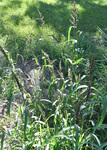
Poaceae: Echinochloa muricata
Files
Family Name
Poaceae
Common Name
Rough barnyard grass, common barnyard grass
Description
Echinochloa muricata is an annual grass growing from a fibrous root system. Stems are 30 to 100 cm in height, erect and robust, often branched near the top, usually smooth or slightly rough, with a round to slightly flattened cross-section. Leaves are alternate and linear-lanceolate, 10–30 cm long and 1–2 cm wide, with rough margins and a prominent midrib. The leaf sheath encloses the stem partially; the ligule is membranous, short, and translucent. Flowering occurs from mid to late summer (July–September). The inflorescence is a large, open, pyramidal to somewhat contracted panicle up to 20 cm long, composed of many spikelets. Each spikelet is flattened, lanceolate, about 3–6 mm long, green to purplish, bearing one to several florets. Spikelets have a scabrous (rough) surface covered with minute prickles (muricate texture), which gives the species its name. Each floret has three stamens and two feathery stigmas. The fruit is a small, oval caryopsis (grain), enclosed within a hardened lemma and palea, brown at maturity and 1.5–2 mm long, maturing in late summer. Rough barnyard grass is native to South Dakota, found in wetlands, ditches, floodplains, moist fields, and disturbed wet sites statewide, especially in eastern parts of the state.
Horticulture Notes
Seed Collection: Seeds mature when panicles dry and spikelets turn brown; seeds can be harvested in late summer.
Germination: Seeds germinate readily without special dormancy requirements; best sown in spring in moist, well-drained soils.
Vegetative Propagation: Not propagated vegetatively; spreads by seed.
Soils: Prefers moist to wet soils including clay, loam, and sandy substrates.
Light: Thrives in full sun to partial shade.
Water: Requires moist to saturated soils; tolerant of standing water and periodic flooding.
Additional Notes
While sometimes considered a weed in agricultural systems, rough barnyard grass is valuable in wetland and riparian ecosystems, providing food and habitat for waterfowl and aquatic wildlife. It helps stabilize soils in flood-prone areas.