

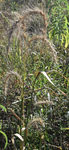
Poaceae: Elymus canadensis
Files
Family Name
Poaceae
Common Name
Canada wildrye
Native American Name
Lakota: pteyáȟota
Description
Elymus canadensis is a perennial cool-season bunchgrass growing from a robust, fibrous root system forming clumps rather than sod. . Stems (culms) are sturdy, erect, rigid, and typically 60–150 cm tall, smooth to slightly rough. Leaves are alternate, flat, and linear, typically 10 to 30 centimeters long and 5 to 15 millimeters wide, with rough margins and a blunt or tapered tip and sheaths that tightly wrap the stem. Both basal and cauline leaves are present. The ligule is prominent, translucent, membranous, about 2 to 5 millimeters long, with a finely toothed or jagged margin. The inflorescence is a dense, spike-like raceme 10 to 30 centimeters long, composed of several spikelets arranged in two rows along the axis. Each spikelet is 10 to 15 millimeters long, containing 2–5 florets with awns 1–3 cm long. Flowers are bisexual, with three stamens with slender filaments and large anthers and a single pistil topped with two feathery stigmas The fruit is a caryopsis (grain), 5–7 mm long, brown at maturity, ripening in late summer. Canada wild rye is native to South Dakota, growing in prairies, open woodlands, roadsides, and disturbed sites statewide, with higher abundance in central and eastern regions.
Horticulture Notes
Seed Collection: Seeds mature when spikes turn golden brown and seeds are firm, typically late summer; harvest by cutting and threshing spikelets.
Germination: Seeds germinate best after cold stratification (30–60 days); sow in fall or spring after stratification.
Vegetative Propagation: Not commonly propagated vegetatively; grown primarily from seed.
Soils: Prefers well-drained loam to sandy soils but tolerates clay and rocky substrates.
Light: Full sun is ideal.
Water: Moderately drought-tolerant; benefits from occasional moisture during establishment.
Additional Notes
Canada wild rye is native and widely valued for prairie restoration, erosion control, and forage. It provides habitat and food for native insects and wildlife. The species is drought-tolerant and adaptable, used in natural landscaping and conservation plantings.