

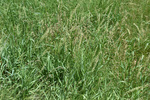
Poaceae: Elymus repens
Files
Family Name
Poaceae
Common Name
Quackgrass, couch grass
Description
Elymus repens is a perennial, cool-season grass that spreads aggressively via rhizomes, often forming dense mats. Stems (culms) are erect to arching, simple to sparingly branched, typically 30–120 cm tall, smooth or slightly roughened near the nodes. Leaves are alternate, flat, linear, typically 10 to 30 centimeters long and 5 to 12 millimeters wide, with rough margins, a pointed tip and sheathing bases. The ligule is membranous, about 2 to 4 millimeters long, with a jagged or irregular margin. The inflorescence is a slender, spike-like raceme 10 to 25 centimeters long, composed of numerous spikelets arranged in two rows along the axis. Spikelets are 10 to 18 millimeters long, each containing 2–4 florets with long awns often 3–6 cm in length giving the spikes a bristly look. Flowers are bisexual with three stamens and a single pistil crowned with two feathery stigmas. Fruits are caryopses (grains) about 4 to 7 millimeters long, enclosed by the lemma and palea. Seed maturation occurs from late summer to early fall. Quackgrass is native to Europe and parts of Asia. It is naturalized in South Dakota and considered an invasive weed, abundant in croplands, roadsides, disturbed soils, and pastures statewide.
Additional Notes
Quackgrass is primarily known as a problematic weed due to its aggressive spreading by rhizomes, which can outcompete crops and native plants. Despite this, it can provide soil stabilization and erosion control. It is palatable to some grazing animals in early growth stages but is not favored as forage once mature.