

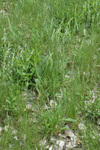
Poaceae: Koeleria macrantha
Files
Family Name
Poaceae
Common Name
Junegrass, prairie Junegrass
Description
Koeleria macrantha is a perennial bunchgrass typically growing 15 to 60 cm tall. It grows from a fibrous root system forming tufts or clumps. The stems are slender, erect, and generally glabrous or finely pubescent. Leaves are mostly basal and alternate along the stem, simple and linear, measuring about 5 to 15 cm long and 2 to 5 mm wide, with entire margins and smooth to slightly rough surfaces due to minute hairs. Leaf sheaths are open, smooth or slightly pubescent, and mostly shorter than the internodes. The ligule is membranous, short (1–2 mm), and rounded to truncate. The inflorescence is an open, narrow panicle that flowers from late spring to early summer (May–July). Spikelets are about 8 to 15 mm long, each containing several florets with three stamens per floret. The pistil consists of a single ovary with two feathery stigmas. The fruit is a small caryopsis (grain) about 2 to 3 mm long. In South Dakota, Junegrass is native and commonly found in dry prairies, open rocky slopes, and well-drained sandy or gravelly soils across much of the state.
Horticulture Notes
Seed Collection: Collect mature seeds from dry panicles in late summer.
Germination: Seeds germinate best when sown in fall or after cold stratification.
Vegetative Propagation: Primarily by seed; vegetative propagation is rare.
Soils: Prefers well-drained sandy or rocky soils.
Light: Thrives in full sun.
Water: Drought tolerant; prefers dry to moderately moist conditions.
Additional Notes
Junegrass provides forage for wildlife and livestock, especially in dry rangelands. It helps in erosion control and is valued for native prairie restoration.