

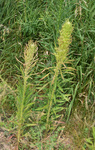
Asteraceae: Erigeron canadensis
Files
Family Name
Asteraceae
Common Name
Canadian horseweed, Canadian fleabane
Description
Erigeron canadensis is a fast-growing, annual or short-lived perennial herb growing from a fibrous root system, with slender stems that are typically 30 to 150 tall, erect, branched, and often sparsely hairy to nearly glabrous. Leaves are alternate, narrowly lanceolate to linear, measuring 2 to 10 cm long and 0.5 to 1.5 cm wide, with short petioles or sessile bases and finely serrate to entire margins. Flowering occurs from late summer to fall (July–October), producing open, branching panicles of numerous small flower heads . Each flower head is about 1–2 cm across, with 40–100 white to pale lavender ray florets, 2 to 4 mm long, surrounding yellow disc florets. Flowers are bisexual, with five-lobed corollas, 5 stamens fused by their anthers into a tube surrounding the style, and a single pistil with a slender style bifurcated at the tip into two slender, elongated stigmatic branches. The involucre is composed of several series (3 to 4 rows) of narrow, greenish to pale bracts (phyllaries) that are lanceolate and often slightly membranous with finely fringed or ciliate margins, forming a cup-shaped structure surrounding the base of the composite flower head. The fruit is a small, ribbed achene about 1 to 2 millimeters long with a pappus of fine bristles aiding wind dispersal. Seeds mature in early fall. Canadian horseweed is native to North America and widespread throughout South Dakota, commonly found in disturbed sites, roadsides, fields, and open areas.
Horticulture Notes
Seed Collection: Seeds mature when flower heads dry and pappus is fully expanded; seeds disperse easily by wind, typically in late summer.
Germination: Seeds germinate readily without dormancy; best sown in spring on disturbed or bare soil.
Vegetative Propagation: None; reproduces primarily by seed.
Soils: Tolerates a wide range of soils, including poor, disturbed sites.
Light: Full sun preferred.
Water: Thrives in dry to moderately moist conditions; drought tolerant once established.
Additional Notes
Canada fleabane provides nectar for pollinators, including bees and butterflies. It is recognized for early succession on disturbed sites but can become weedy and invasive in agricultural areas. Some traditional uses include medicinal applications for fevers, respiratory ailments, and insect repellents.