

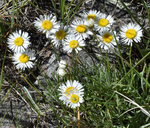
Asteraceae: Erigeron flagellaris
Files
Family Name
Asteraceae
Common Name
Whip fleabane
Description
Erigeron flagellaris is a low, mat-forming perennial herb growing from a fibrous root system and spreads asexually by slender, trailing stolons or “whips,” which root at nodes to form new plants. Stems are slender, prostrate to ascending, typically 5–15 cm tall but spreading laterally much farther. Leaves are alternate, narrow, linear to lanceolate, 1–4 cm long and 1–3 mm wide, mostly basal or along the lower stem, with smooth margins and a somewhat rough texture and covered with fine hairs giving a gray-green appearance. The few cauline leaves that are present are smaller, and scale-like. Flowering occurs in spring and summer (April–July). Each flower head is about 1–1.5 cm wide, with 15–35 narrow white to pale lavender ray florets surrounding numerous yellow disc florets. The ray flowers are strap-shaped, about 5–8 mm long and 1–2 mm wide. Disc flowers are tubular, bright yellow, and fertile with five stamens fused into a tube around the style. The style ends in two slender, slightly hairy stigmatic branches. The involucre phyllaries are narrow, lanceolate, measuring about 5–10 mm long, with pointed tips and somewhat hairy. The fruit is a small achene with a pappus of fine bristles for wind dispersal, maturing in early summer. Whip fleabane is native to South Dakota, growing in dry open woods, rocky slopes, grasslands, and sandy soils, especially in western and central regions.
Horticulture Notes
Seed Collection: Seeds mature when flower heads dry and seed fluff is exposed, typically early to mid-summer.
Germination: Seeds germinate readily without pretreatment; sow in spring or fall on well-drained soils.
Vegetative Propagation: Commonly propagated by stolon division or layering.
Soils: Prefers dry, sandy, or rocky soils with good drainage.
Light: Thrives in full sun.
Water: Drought-tolerant; needs minimal water once established.
Additional Notes
Whip fleabane is valued for ground cover and erosion control in dry and rocky habitats. It provides nectar to native pollinators and is adapted to withstand drought.