

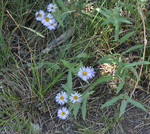
Asteraceae: Erigeron speciosus var. macranthus
Files
Family Name
Asteraceae
Common Name
Showy fleabane, aspen fleabane
Description
Erigeron speciosus is a perennial herbaceous plant known for its showy, daisy-like flower heads. It typically grows 30–90 cm tall with erect, simple to branched, moderately hairy stems arising from a woody base or short rhizomes. Leaves are alternate, lanceolate to ovate-lanceolate, 5–15 cm long and 1–5 cm wide, with smooth or slightly toothed margins and a rough texture. Lower leaves often have petioles, while upper leaves may clasp the stem.
Flowering occurs from mid-summer to early fall (July–September). Inflorescences are composed of numerous large, showy flower heads with lavender to purple ray florets and yellow disc florets, arranged in loose clusters or solitary at stem tips. The involucre consists of a series of green to reddish-green overlapping bracts that are broadly lanceolate to ovate, 10–15 mm long, with pointed tips and a somewhat hairy or glandular texture. Each flower head contains 60–120 bright lavender to pale purple, occasionally white ray florets that are strap-shaped, about 12–18 mm long and 2–4 mm wide, mostly sterile or female, primarily serving to attract pollinators. The disc florets are tubular, perfect (bisexual), bright yellow, 3–4.5 mm in length. The corolla tube has five lobes that spread slightly as the flower matures. The five stamens are fused by their anthers into a tube surrounding the style. The style extends through the anther tube, the tip of the style divides into two slender, slightly hairy stigmatic branches. Fruit is a small achene with a pappus of many fine, white bristles and matures in late summer. Showy fleabane is native to South Dakota, occurring in montane meadows, open woods, and rocky slopes, mainly in western and central parts of the state.
Horticulture Notes
Seed Collection: Seeds mature as flower heads dry and pappi develop, typically late summer.
Germination: Seeds germinate readily; no special treatments needed; best sown in spring or fall.
Vegetative Propagation: Not common; plants are typically propagated by seed.
Soils: Prefers well-drained, sandy or rocky soils.
Light: Full sun to light shade.
Water: Requires moderate moisture; drought-tolerant once established.
Additional Notes
Showy fleabane is especially prized in native plant gardens and wildflower mixes for its larger, showy flowers that attract a broad range of pollinators such as bees and butterflies.