

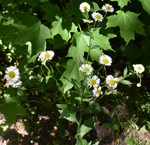
Asteraceae: Erigeron strigosus
Files
Family Name
Asteraceae
Common Name
Prairie fleabane, stiff fleabane
Description
Erigeron strigosus is an annual or biennial herbaceous plant that typically grows 30–80 cm tall with erect, slender, and often branched stems. The stems and leaves are covered with fine, stiff hairs (strigose), giving the plant a rough texture and a slightly grayish-green appearance. Leaves are alternate, narrow lanceolate to linear, 3–10 cm long and 0.5–2 cm wide, with entire to coarse toothed margins; basal leaves have petioles and form a rosette early in the season and usually wither by flowering time, while cauline leaves are smaller and clasping. Flowering occurs from summer to early fall (June–September). Inflorescences are composed of numerous small flower heads borne in loose clusters or solitary at stem tips. The phyllaries of the involucre are arranged in 2–3 overlapping series, narrow and lanceolate, about 5–8 mm long, with pointed tips and a rough, hairy texture. Their color ranges from green to reddish green, sometimes with translucent margins. Each flower head is 1–1.5 cm across, with white to pale pink or lavender ray florets surrounding yellow disc florets. Each flower head contains 30–60 narrow white to pale lavender ray florets surrounding numerous bright yellow disc florets. The ray florets are strap-shaped, about 5–10 mm long and 1–2 mm wide, mostly sterile or female, serving to attract pollinators. The disc florets are tubular, perfect (bisexual), measuring about 2.5–3.5 mm in length. The corolla has five lobes that spread slightly as the flower matures. The disc florets have five stamens fused by their anthers into a tube surrounding the style. The style extends through the anther tube and is divided into two slender, slightly hairy stigmatic branches. The fruit is a small achene with a pappus of fine bristles, maturing in late summer. Prairie fleabane is native to South Dakota and common in prairies, roadsides, fields, and disturbed sites statewide.
Horticulture Notes
Seed Collection: Seeds mature when flower heads dry and pappus develops, typically late summer.
Germination: Seeds germinate readily without dormancy; sow in spring or fall in well-drained soils.
Vegetative Propagation: None; reproduction primarily by seed.
Soils: Adaptable to a range of soils, including sandy and loamy substrates.
Light: Prefers full sun to partial shade.
Water: Tolerates dry to moderately moist soil conditions; drought tolerant once established.
Additional Notes
Prairie Fleabane is often considered a weed but plays a role in prairie ecosystems and natural succession, providing nectar and pollen for various pollinators, including bees and butterflies.