

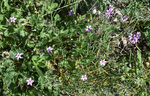
Geraniaceae: Erodium cicutarium
Files
Family Name
Geraniaceae
Common Name
Redstem Filaree, Common Stork’s-bill
Description
Erodium cicutarium is an annual or biennial taprooted herbaceous species that initially forms a rosette with stems that typically grow 10–50 cm tall. The stems are slender, often reddish or purplish, and may be hairy or smooth. Leaves are 3–10 cm long, pinnately divided with narrow lobes, giving a fern-like appearance. Flowering occurs from spring through late summer (April–September). The flowers are borne singly or in small clusters on slender stalks. Flowers are small, typically 1–2 cm across, with five pink to purple petals that measure 10 to 15 mm in length and about 4 to 7 mm in width. Their edges are smooth, and the petals have a delicate, slightly translucent texture that enhances the visibility of the darker venation. The sepals are generally smaller than the petals, measuring about 6 to 9 millimeters long and 1.5 to 3 millimeters wide. They are often covered with fine hairs, giving them a slightly fuzzy appearance. Flowers are bisexual, with five stamens and a pistil. Fruit is distinctive: a long, beak-like style attached to a small seed capsule, this "stork's-bill" shape aids in seed dispersal by “catapulting” seeds away. Common Stork’s-bill is introduced and widespread in South Dakota, growing in disturbed sites, roadsides, fields, and grasslands, especially in drier areas.
Additional Notes
Common Stork’s-bill is introduced and considered a weed in South Dakota. However, it has been used traditionally in herbal medicine to treat minor wounds and digestive issues. It is also forage for livestock early in the season.