

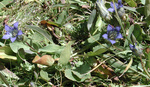
Gentianaceae: Gentiana affinis
Family Name
Gentianaceae
Common Name
Prairie gentian
Description
Gentiana affinis is a perennial, herbaceous plant with a fibrous root system and short rhizomes, forming low clumps. Mature plants typically reach 10–40 cm in height. Stems are erect, slender, and usually unbranched, with a smooth surface. Leaves are opposite or whorled, simple, lanceolate to elliptic, 2–8 cm long and 0.5–2 cm wide, with entire margins and acute tips. Leaf surfaces are dark green and glabrous on both sides. Petioles are absent or very short. Flowering occurs from July to September, with solitary or paired, large, tubular, trumpet-shaped flowers about 3–5 cm long. Flowers are typically deep blue to violet, sometimes with lighter markings, and remain closed or only slightly open at the mouth (hence “closed gentian”). The calyx is composed of five green sepals, 10–15 mm long, lanceolate and free or slightly fused at the base. The corolla is tubular with five lobes, 30–50 mm long, with a smooth texture and slightly flared tips. Stamens number five, attached to the corolla tube, with yellow anthers. The pistil is single, with a superior ovary, slender style, and capitate stigma. The fruit is a dry, dehiscent capsule, 15–25 mm long, containing numerous small seeds, maturing from late summer to early fall. Prairie gentian is native to South Dakota and is found in western prairies, open meadows, and rocky slopes, favoring well-drained, sandy to loamy soils in full sun to partial shade.
Horticulture Notes
Seed collection: Collect capsules in late summer to early fall (August–September) when ripe and beginning to split.
Germination: Seeds may require cold, moist stratification (60–90 days); sow in fall or stratify and sow in spring.
Vegetative propagation: Rarely propagated vegetatively; primarily grown from seed.
Soils: Prefers well-drained, sandy to loamy soils.
Light: Thrives in full sun to partial shade.
Water: Prefers moderate moisture; tolerates short dry periods but not prolonged drought.
Additional Notes
Prairie gentian is valued horticulturally for its striking blue flowers and as a native wildflower suitable for prairie restorations and naturalistic gardens. Ecologically, it attracts specialized pollinators, including bumblebees, and contributes to prairie biodiversity.