

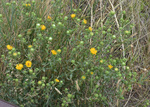
Asteraceae: Grindelia squarrosa
Files
Family Name
Asteraceae
Common Name
Curlycup gumweed
Native American Name
Lakota: pté íčhiyuha
Description
Grindelia squarrosa is a perennial herbaceous or short-lived perennial plant that grows from a deep taproot, known for its sticky, resinous foliage and distinctive flower heads. It typically grows 30–90 cm tall with erect, branching stems. Leaves are alternate, sticky, glandular, and covered with resinous exudates giving a sticky texture and shiny appearance, sessile, lanceolate to ovate-lanceolate in shape, typically measuring 5 to 15 cm long and 1 to 4 cm wide, with smoothed or entire margins, a rounded to slightly tapered base and a generally acute or pointed tip. Leaves tend to be narrower and more lance-shaped on the upper stems, while the lower leaves are broader and sometimes more ovate. Flowering occurs from mid-summer to early fall (July–September). Inflorescences are large, solitary flower heads 3–5 cm across, with bright yellow ray florets surrounding a dense cluster of yellow disc florets. The involucre consists of several series of broad, pointed phyllaries that are green to reddish-green, often with resinous glands. Each flower head contains numerous yellow ray florets surrounding a dense cluster of yellow disc florets. The ray florets are strap-shaped, about 12–20 mm long, mostly sterile or female, serving to attract pollinators. The disc florets are tubular, perfect (bisexual), about 4–5 mm long, with a corolla tube lobed into five spreading lobes. The disc florets have five stamens fused by their anthers into a tube around the style. The style extends through the anther tube that divides into two slender, slightly hairy stigmatic branches. The flowers emit a distinctive resinous scent. Fruit is an achene with a pappus of fine bristles, maturing in late summer. Curlycup gumweed is native to South Dakota, commonly found in dry, disturbed areas, roadsides, grasslands, and open woods statewide.
Horticulture Notes
Seed Collection: Seeds mature as flower heads dry and pappi develop, usually late summer.
Germination: Seeds germinate readily; best sown in spring or fall on well-drained soil.
Vegetative Propagation: Rarely propagated vegetatively; mainly by seed.
Soils: Prefers dry, sandy, or rocky soils; tolerates poor nutrient conditions.
Light: Full sun required.
Water: Drought tolerant; minimal watering needed once established.
Additional Notes
Historically used by Indigenous peoples and herbalists for respiratory ailments, skin conditions, and as an anti-inflammatory agent. The sticky resin was applied topically to wounds and rashes. It supports pollinators like bees and butterflies. The plant is non-toxic but its resin can cause contact irritation for sensitive skin.