

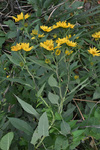
Asteraceae: Helianthus grosseserratus
Files
Family Name
Asteraceae
Common Name
Sawtooth sunflower
Description
Helianthus grosseserratus is a tall, perennial herbaceous plant in the Asteraceae family. It grows from a robust rhizome system that supports clonal spread. Stems are erect, sturdy, and typically range from 1.5 to 3 meters in height. The leaves are large, lanceolate to ovate-lanceolate, with distinctly saw-toothed (serrated) edges—hence the name "sawtooth." Leaf size ranges from 10 to 20 cm long and 4 to 8 cm wide. They have rough, hairy surfaces with prominent veins and an acute to acuminate tip. Leaves are arranged alternately along the stem and attach via short petioles. The plant flowers from mid to late summer (July to September). Its inflorescences are large, bright yellow flower heads, 7 to 15 cm in diameter, with bright yellow ray florets surrounding a central disk of deep brown to purple disk florets. Each flower head has an involucre of several series of overlapping lanceolate green phyllaries about 15 to 25 mm long, often with hairy margins. The ray florets number about 12 to 20, each strap roughly 3 to 6 cm long and 1 to 2 cm wide, oblong to spatulate in shape with smooth edges. The disc florets are tubular, perfect (bisexual), about 5 to 7 mm long, with five lobes at the corolla tip. The 5 stamens are fused into a tube around the style. The style divides into two stigmatic branches. The fruit produced is a dry achene 4 to 6 mm in length, with a pappus of small scales that matures toward the end of summer or early fall. Sawtooth sunflower is native to South Dakota, favoring moist prairies, riverbanks, wetlands, and open woodlands throughout the state.
Horticulture Notes
Seed Collection: Collect seeds in late summer when the flower heads dry; harvested by removing dried heads and extracting the seeds.
Germination: Seeds germinate best following cold stratification; sow them in fall or spring on moist, well-draining soil.
Vegetative Propagation: Can also be propagated by dividing rhizomes.
Soils: Prefers moist, fertile soils but adapts well to various soil types including clay and loam.
Light: Requires full sun for optimal growth.
Water: Prefers moderate moisture and can tolerate occasional flooding.
Additional Notes
Sawtooth sunflower supports a diverse range of pollinators including bees and butterflies. The plant plays a role in erosion control and habitat stabilization in riparian and wetland ecosystems.