

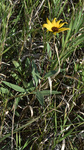
Asteraceae: Helianthus pauciflorus
Files
Family Name
Asteraceae
Common Name
Stiff sunflower, few-flowered sunflower
Description
Helianthus pauciflorus is a perennial herbaceous plant that grows from a thick, underground rhizome system which allows clonal expansion. Stems are erect, rigid, hairy, and typically 1 to 2 meters tall, often branching near the top. Leaves are simple, alternate, broadly lanceolate to ovate-lanceolate, generally 8 to 18 cm long and 3 to 8 cm wide. The leaf margins are coarsely serrated, with a rough, hairy surface on both sides. Leaves have a pointed tip and a tapered base, attaching to the stem with short petioles. Flowering occurs from mid to late summer (July–September). The flower heads are moderately sized, generally 5 to 10 cm in diameter, with bright yellow ray florets surrounding a central disk of dark brown to reddish-brown disc florets. The involucre consists of several series of lanceolate green phyllaries about 12 to 20 mm long, often with hairy margins. Each flower head contains about 10 to 20 ray florets. The ray florets’ petals are oblong to spatulate, measuring roughly 3 to 5 cm long and 1 to 2 cm wide, with smooth edges. The disc florets are tubular, perfect (bisexual), about 4 to 6 mm long, with five lobes at the corolla tip. The 5 stamens are fused into a tube around the style that divides into two slender stigmatic branches. The fruit is a small achene, 3 to 5 mm long, topped with a pappus of short hairs, maturing in late summer to early fall. Stiff sunflower is native to South Dakota and thrives in prairies, open woodlands, and sandy or rocky soils across the state.
Horticulture Notes
Seed Collection: Seeds mature as flower heads dry in late summer; harvest and clean for propagation.
Germination: Seeds benefit from cold stratification; sow in fall or spring or after 6 weeks cold stratification, in well-drained soil.
Vegetative Propagation: Propagation through division of rhizomes is possible.
Soils: Prefers well-drained sandy or loamy soils; tolerates rocky soil.
Light: Requires full sun.
Water: Prefers moderate moisture, but is drought tolerant when established.
Additional Notes
Stiff sunflower supports pollinators including bees and butterflies and provides food for birds through its seeds. Sunflowers hold cultural significance in Indigenous communities for food and medicine. Helianthus pauciflorus is valuable in restoration and erosion control projects.