

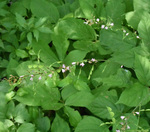
Fabaceae: Hylodesmum glutinosum
Files
Family Name
Fabaceae
Common Name
Large tick-trefoil
Description
Hylodesmum glutinosum is a perennial, herbaceous vine or sprawling plant in the Fabaceae family. It grows from a deep taproot and produces slender, sometimes hairy, trailing or climbing stems typically growing from 30 to 90 (140) cm tall. Leaves are alternate, trifoliate, with each leaflet ovate to elliptical, 3–7 cm long and 1.5–3 cm wide, with entire to slightly toothed margins. Each trifoliate leaf is attached to the stem by a petiole, with small, leaf-like stipules at the base of each leaf petiole. Leaflets are attached to the petiole by short stalks called petiolules. Flowering occurs mid to late summer (June–September). Flowers are pea-shaped, 1–1.5 cm long, purplish pink to lavender, appearing singly or in small clusters in leaf axils. The calyx has five sepals fused into a tubular base with five pointed lobes, 5 to 8 mm long and often glandular-hairy. The corolla consists of five petals typical of legumes: one large upright banner, two lateral wings, and two fused keel petals, ranging from 12 to 20 mm long. There are 10 stamens arranged in a diadelphous configuration; nine stamens are fused together into a tube surrounding the pistil, while one stamen remains free. The pistil is superior with a single carpel; the slender style curves upward to a small stigma. Fruits are legume pods measuring 3 to 6 cm long, slightly sticky or glandular, containing several seeds, and mature in summer to early fall. In South Dakota, large tick-trefoil is typically found in eastern and southeastern regions where habitats include open woodlands, prairies, thickets, streambanks, and sometimes along roadsides or disturbed areas.
Synonym: Desmodium glutinosum
Horticulture Notes
Seed Collection: Collect pods before natural dehiscence in late summer to early fall.
Germination: Seeds benefit from scarification and cold stratification. Plant in the fall for best results.
Vegetative Propagation: Possible by stem cuttings or division.
Soils: Prefers well-drained, often rocky or sandy soils.
Light: Full sun to partial shade.
Water: Prefers moderate moisture; drought tolerant once established.
Additional Notes
Large tick-trefoil is valued ecologically for forage, habitat restoration and nitrogen fixation.