

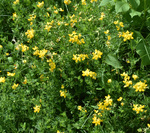
Fabaceae: Lotus corniculatus
Files
Family Name
Fabaceae
Common Name
Bird’s-foot trefoil
Description
Lotus corniculatus is a perennial herbaceous legume that spreads by stolons and forms low mats or small clumps. Stems are slender, trailing or ascending, typically 10–50 cm long, and often glabrous or sparsely hairy. Leaves are alternate and compound, typically trifoliate with three leaflets measuring about 1 to 3 cm long and 0.5 to 1.5 cm wide; leaflets are obovate to elliptic with entire margins and smooth surfaces, sessile or have very short petiolules, about 5–20 mm long and 3–10 mm wide, with small stipules at the base of the leaf stalks. Flowering takes place from late spring through early fall (May–September). The inflorescence is an umbel-like cluster of 3 to 10 flowers. Flowers are bright yellow, sometimes with orange-red tinges on the petals, about 1 to 1.5 cm long, with a typical papilionaceous structure: a broad, rounded standard petal, two lateral wing petals, and a keel formed by two fused petals. Each flower is subtended by a calyx of five sepals fused at the base into a tubular cup about 5 to 8 mm long, with five pointed lobes that are lanceolate to ovate in shape and covered with fine hairs. Flowers have ten stamens, nine of which are fused, and a superior ovary. The fruit is a slender, curved pod about 2 to 4 cm long containing several seeds Bird’s-foot trefoil is native to Eurasia but widely naturalized and invasive in South Dakota, often found in pastures, roadsides, pastures, grasslands, and disturbed sites statewide.
Horticulture Notes
Seed Collection: Collect pods when dry in late summer.
Germination: Seeds have hard coats; scarification improves germination.
Vegetative Propagation: Spreads readily by stolons.
Soils: Prefers well-drained soils, tolerates a wide range of soil types.
Light: Full sun to partial shade.
Water: Prefers moderate moisture but drought tolerant once established.
Additional Notes
Birdsfoot Trefoil is widely used as forage, for soil stabilization, and in reclamation due to its nitrogen-fixing ability. It supports pollinators but can outcompete native plants where invasive. It is not recommended for native garden plantings.