

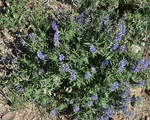
Fabaceae: Lupinus argenteus
Files
Family Name
Fabaceae
Common Name
Silvery lupine
Native American Name
Lakota: čhaŋȟlóǧaŋ nabláya
Description
Lupinus argenteus is a perennial herbaceous plant growing 30 to 90 cm tall. It has a fibrous root system with occasional short rhizomes but no stolons. The stems are erect, often covered with silvery, silky hairs giving the plant a grayish appearance. Leaves are alternate and palmately compound, typically with 7 to 11 narrow leaflets measuring about 2 to 5 cm long and 0.5 to 1 cm wide; leaflets are linear to lanceolate with entire margins and covered in fine silvery hairs. Leaf petioles are 5 to 15 cm long. The inflorescence is a dense raceme of pea-shaped flowers blooming from late spring to mid-summer (June–August). Each flower is subtended by a calyx of five sepals fused into a tubular structure about 6 to 10 mm long, with five pointed lobes that are ovate to lanceolate and densely covered with silvery hairs, each lobe measuring approximately 3 to 5 mm long and 1.5 to 3 mm wide. Flowers are typically blue to purple, about 10 to 15 mm long, with the classic papilionaceous form: the standard petal is broadly ovate and 8 to 12 mm long and 6 to 9 mm wide; the two wing petals are about 7 to 10 mm long and 3 to 5 mm wide; and the keel formed by two fused petals is about 7 to 11 mm long and 3 to 4 mm wide. Flowers have ten stamens, nine of which are fused, and a superior ovary. The fruit is a pod approximately 3 to 6 cm long containing several seeds. In South Dakota, Silvery lupine is native and found in dry open woods, meadows, and rocky slopes primarily in the western and Black Hills regions.
Horticulture Notes
Seed Collection: Collect pods when mature and dry in late summer.
Germination: Seeds have hard coats; scarification and cold stratification improve germination. Fall planting is often best.
Vegetative Propagation: Primarily from seed; vegetative propagation uncommon.
Soils: Prefers well-drained, often sandy or rocky soils.
Light: Full sun to partial shade.
Water: Prefers moderate moisture; drought tolerant once established.
Additional Notes
Silvery Lupine is valued for its role in nitrogen fixation, as forage for wildlife, and can be used in revegetation.