

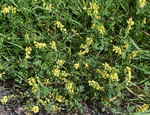
Fabaceae: Medicago lupulina
Files
Family Name
Fabaceae
Common Name
Black medick, black clover, hop clover
Native American Name
Lakota: waȟpé swúla
Description
Medicago lupulina is an annual or short-lived perennial herbaceous plant growing 10 to 50 cm tall. It has a fibrous root system with occasional short stolons allowing it to spread across the ground. The stems are slender, often sprawling or ascending, and glabrous to sparsely hairy. Leaves are alternate and trifoliate, with three oval to obovate leaflets measuring about 0.8 to 2.5 cm long and 0.5 to 1.5 cm wide; leaflets have entire or slightly serrated margins and smooth surfaces. Leaflets are sessile or have very short petiolules, and stipules are small and lanceolate at the base of the leaf stalks. The inflorescence is a small, dense raceme or head of 5 to 20 bright yellow, pea-shaped flowers blooming from late spring through summer (May–August). Each flower is subtended by a calyx of five sepals fused at the base into a tubular cup about 3 to 5 mm long, with five pointed lobes that are lanceolate and often hairy. Flowers are about 5 to 8 mm long. The corolla’s standard petal is broadly ovate, measuring approximately 5 to 7 mm long and 4 to 6 mm wide; the wing petals are about 4 to 6 mm long and 2 to 3 mm wide; and the keel, formed by two fused petals, is about 4 to 7 mm long and 1.5 to 3 mm wide. Flowers have ten stamens, nine of which are fused, and a superior ovary. Fruits are coiled, single-seeded pods resembling tiny spirals, maturing in late summer. Black medick is native to Eurasia but naturalized widely in North America, including South Dakota, often found in lawns, pastures, roadsides, and disturbed sites statewide.
Additional Notes
Black Medic is often used as a cover crop and green manure due to its nitrogen-fixing ability, valued as forage for livestock and soil improvement. It attracts pollinators like bees and benefits soil health. It is not recommended for native plantings.