

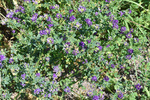
Fabaceae: Medicago sativa
Files
Family Name
Fabaceae
Common Name
Alfalfa
Native American Name
Lakota: waȟpókhižate, tȟačháŋičahu tȟáŋka
Description
Medicago sativa is a perennial herbaceous plant growing 30 to 100 cm tall, often forming dense stands. It has a deep, extensive taproot system that allows it to access deep soil moisture. The stems are erect to ascending, slender, and typically glabrous or sparsely hairy. Leaves are alternate and trifoliate, with three oval to oblong leaflets measuring about 1.5 to 4 cm long and 0.8 to 2 cm wide; leaflets have smooth or slightly serrated margins and a fine, soft pubescence on the surface. Leaflets are petiolulate with short stalks about 2 to 5 mm long, and stipules are small and lanceolate at the base of the leaf stalks. The inflorescence is a raceme or spike-like cluster of 10 to 40 pea-shaped flowers blooming from late spring through summer (May–August). Each flower is subtended by a calyx of five sepals fused at the base into a tubular cup about 5 to 8 mm long, with five pointed lobes that are lanceolate to ovate and often covered with fine hairs. Flowers are about 10 to 15 mm long. The corolla’s standard petal is broadly ovate and measures approximately 9 to 14 mm long and 7 to 10 mm wide; the wing petals are about 8 to 12 mm long and 3 to 5 mm wide; the keel, formed by two fused petals, is about 8 to 13 mm long and 3 to 5 mm wide. Flowers are typically purple to violet, sometimes pink or white. Flowers have ten stamens, nine of which are fused, and a superior ovary. The fruit is a spiral coiled pod about 2 to 4 cm long containing several seeds, maturing from late summer to early fall. Alfalfa is native to southwestern Asia but widely cultivated and naturalized in North America, including South Dakota. Primarily used as a forage crop, it is occasionally found naturalized along roadsides and disturbed sites.
Additional Notes
Alfalfa is cultivated and highly valued for its high protein forage quality, nitrogen fixation, and soil improvement.