

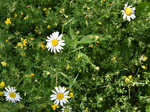
Asteraceae: Leucanthemum vulgare
Files
Family Name
Asteraceae
Common Name
Oxeye daisy
Description
Leucanthemum vulgare is a perennial herbaceous plant typically growing 20 to 80 cm tall. It has a fibrous root system with short rhizomes. The stems are erect and glabrous to sparsely hairy. Leaves are alternate and simple, with the basal leaves being spatulate to ovate-lanceolate, measuring about 5 to 15 cm long and 1 to 4 cm wide, and the upper stem leaves becoming smaller and more lance-shaped. Leaf margins are irregularly toothed or lobed, and the surfaces are mostly smooth. Leaves are sessile or have very short petioles, usually less than 1 cm. The inflorescence is a solitary flower head (capitulum) borne on a long peduncle, flowering from late spring through summer (May–August). The flower heads are 3 to 6 cm in diameter, composed of numerous white ray florets approximately 15 to 25 mm long and 4 to 7 mm wide surrounding a central disc of yellow tubular disc florets about 5 to 8 mm long. The flower head is subtended by several rows of green to straw-colored bracts (involucre) that are lanceolate to ovate and typically 10 to 20 mm long. The fruit is a small achene about 2 to 3 mm long. In South Dakota. Oxeye daisy is native to Europe but widely naturalized and considered invasive in South Dakota. It is commonly found in disturbed prairies, grasslands, meadows, roadsides, and disturbed sites.
Horticulture Notes
Seed Collection: Collect seeds from dried flower heads in late summer.
Germination: Seeds germinate readily without special treatment; sow in spring.
Vegetative Propagation: Spreads easily by rhizomes.
Soils: Prefers well-drained soils but adaptable to a range of conditions.
Light: Prefers full sun to partial shade.
Water: Moderate moisture preferred; tolerates drought once established.
Additional Notes
Oxeye Daisy is considered a weed but is also appreciated for its showy flowers and used ornamentally. It is not appropriate for use in native plantings. Traditionally it has been used medicinally for its anti-inflammatory and soothing properties. It has been used to treat wounds, digestive complaints, and respiratory issues. The plant is attractive to pollinators and supports local biodiversity.