

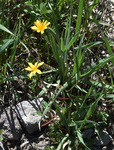
Asteraceae: Microseris nutans
Files
Family Name
Asteraceae
Common Name
Nodding Microseris, nodding silverpuffs
Description
Microseris nutans is a perennial herbaceous plant typically growing 10 to 50 cm tall. It has a deep taproot and a basal rosette of leaves. The leaves are simple, variable in shape but generally lanceolate to oblong, often with irregularly toothed or lobed margins, measuring about 5 to 20 cm long and 1 to 4 cm wide. Leaf surfaces are smooth or slightly hairy, and they are borne on short petioles or sessile. The flowering stalk is leafless, 15–60 cm tall and bears a solitary flower head (capitulum) that nods or droops before opening, hence the name "nodding." Flowering occurs from late spring to midsummer (May–July). The flower head is about 2 to 4 cm in diameter, composed of numerous yellow ray florets that are strap-shaped and typically 15 to 30 mm long. The involucre consists of several series of green to reddish bracts that are lanceolate to ovate and 10 to 20 mm long. The fruit is a small achene with a pappus of fine bristles. Nodding Microseris is native to parts of western North America, including South Dakota, typically found in grasslands, open woods, and rocky slopes, especially in the western and Black Hills regions.
Horticulture Notes
Seed Collection: Collect mature achenes when dry in summer.
Germination: Seeds may require cold stratification; sow in well-drained soil in fall or early spring.
Vegetative Propagation: Typically grown from seed.
Soils: Prefers well-drained soils ranging from sandy to rocky substrates.
Light: Full sun to partial shade.
Water: Moderate moisture preferred; tolerates some drought.
Additional Notes
Nodding Microseris is utilized in native plantings for its delicate flowers and adaptability to various habitats. Microseris nutans, has been traditionally used by Indigenous peoples primarily for its edible roots. The plant produces fleshy tuberous roots that were harvested from the wild as a food source, providing a valuable source of carbohydrates.