

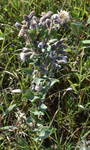
Asteraceae: Nabalus racemosus
Files
Family Name
Asteraceae
Common Name
Small white rattlesnake root, small white lettuce
Description
Nabalus racemosus is a perennial herbaceous plant native to North America. It typically grows 30 to 90 cm tall and emerges from a thick, fleshy, and sometimes branched rootstock. The stems are erect and slender, often branching near the top. The leaves are alternate and mostly basal, becoming smaller and more lanceolate up the stem. Basal leaves can be large, up to 20 cm long, with toothed or lobed margins, while upper stem leaves tend to be narrower and simpler. The surfaces range from smooth to slightly hairy. Flowering occurs from late summer to fall (August to October). The inflorescence is a loose, elongated raceme or panicle of numerous small flower heads, each about 1 to 1.5 cm in diameter. Each flower head consists of white to pale lavender ray florets surrounding yellow disc florets. The ray florets are strap-shaped 10 to 15 mm in length and 2 to 3 mm in width. The disc florets are fertile, 4 to 6 mm long and 1 to 1.5 mm wide, tubular, narrow and cylindrical, with five tiny lobes at the mouth of the opening. The involucre bracts are green, lanceolate, and measure about 5 to 8 mm long, forming a cup around the flower head. Fruits are small achenes, 3 to 5 mm in length, with a pappus of fine bristles, 5 to 7 mm long. White rattlesnake root is native to South Dakota, typically found in moist woodlands, forest edges, and shaded ravines, particularly in the eastern and southeastern parts of the state.
Synonym: Prenanthes racemosa
Horticulture Notes
Seed Collection: Collect mature achenes when dry in early fall.
Germination: Seeds may require cold stratification; sow in well-drained soil in fall or early spring.
Vegetative Propagation: Can be propagated by division of rootstocks.
Soils: Prefers moist, well-drained soils in partial shade.
Light: Partial shade to shade.
Water: Prefers moderate moisture; does not tolerate drought well.
Additional Notes
Small white rattlesnake root provides late-season nectar and pollen for pollinators such as bees and butterflies, supporting biodiversity in woodland and forest edge habitats. It is used in native plant gardens or restoration projects focused on woodland understory species, valued for its delicate, late-summer blooms and ability to thrive in shaded, moist environments.