

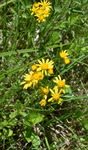
Asteraceae: Packera plattensis
Files
Family Name
Asteraceae
Common Name
Prairie ragwort, prairie groundsel
Native American Name
Lakota: čhaŋȟlóǧaŋ sutá
Description
Packera plattensis is a perennial herbaceous plant growing 20 to 60 cm tall with erect, unbranched or sparsely branched stems covered in fine hairs. It has a fibrous root system with a short, woody caudex at the base, from which multiple stems arise. The basal leaves are petiolate, with petioles 5 to 15 cm long, supporting ovate to lanceolate blades 5 to 12 cm long and 2 to 6 cm wide, often pinnately lobed with irregular teeth. Stem leaves are smaller and sessile or clasping. The inflorescence is a loose corymb of several flower heads blooming from May through July. Each flower head consists of 13 to 21 bright yellow ray florets, each 10 to 18 mm long and 3 to 5 mm wide, surrounding numerous tubular disc florets. The involucre has 2 to 3 series of green, lanceolate bracts, 8 to 12 mm long and 2 to 3 mm wide. The disc florets have five-lobed corollas about 4 to 6 mm long. The stamens number five per disc floret, with slender filaments and yellow anthers fused into a tube around the style. The pistil has a single style with two elongated stigmatic branches approximately 3 to 4 mm long. The fruit is a small, dry achene about 2 to 3 mm long and 1 mm wide, topped with a pappus of white bristles approximately 5 to 7 mm long. Prairie groundsel is native to South Dakota, commonly found in prairies, open fields, and disturbed sites across much of the state.
Synonym: Senecio plattensis
Horticulture Notes
Seed Collection: Collect mature achenes in late summer when dry.
Germination: Seeds require cold stratification for best results; sow in well-drained soil in fall or early spring.
Vegetative Propagation: Possible by division of root crowns.
Soils: Prefers well-drained prairie soils, sandy to loamy.
Light: Full sun.
Water: Tolerant of drought and moderate moisture.
Additional Notes
Prairie ragwort plays an important ecological role in prairie ecosystems, providing nectar and pollen for native bees, butterflies, and other pollinators. It is also used in prairie restoration and native plant gardens as an ornamental wildflower.